Spooky Procedurals: A Taxonomy
The horror-mystery mashup will never be defeated.
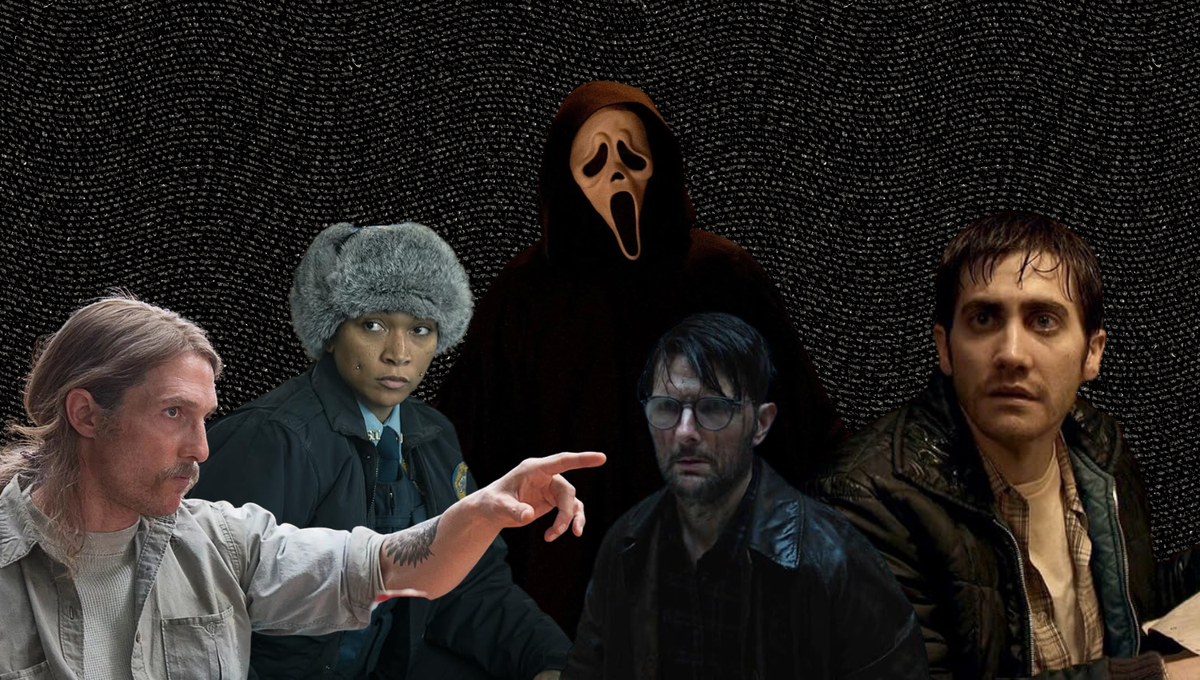
The walls of genre have never been that solid, but they’re practically nonexistent these days. Stories tend to bleed over the boundaries in all kinds of ways. One of my particular favorites is the combination of horror and mystery, or, as I call it, the Spooky Procedural. These two genres work well together, since they so often are built around the unknown and the looming specter of mortality.
After watching and reading many, many Spooky Procedurals, I’ve started to organize these mashups into a few discrete categories. I’ve mapped them based on how much spooky and how much procedural they bring to the story.
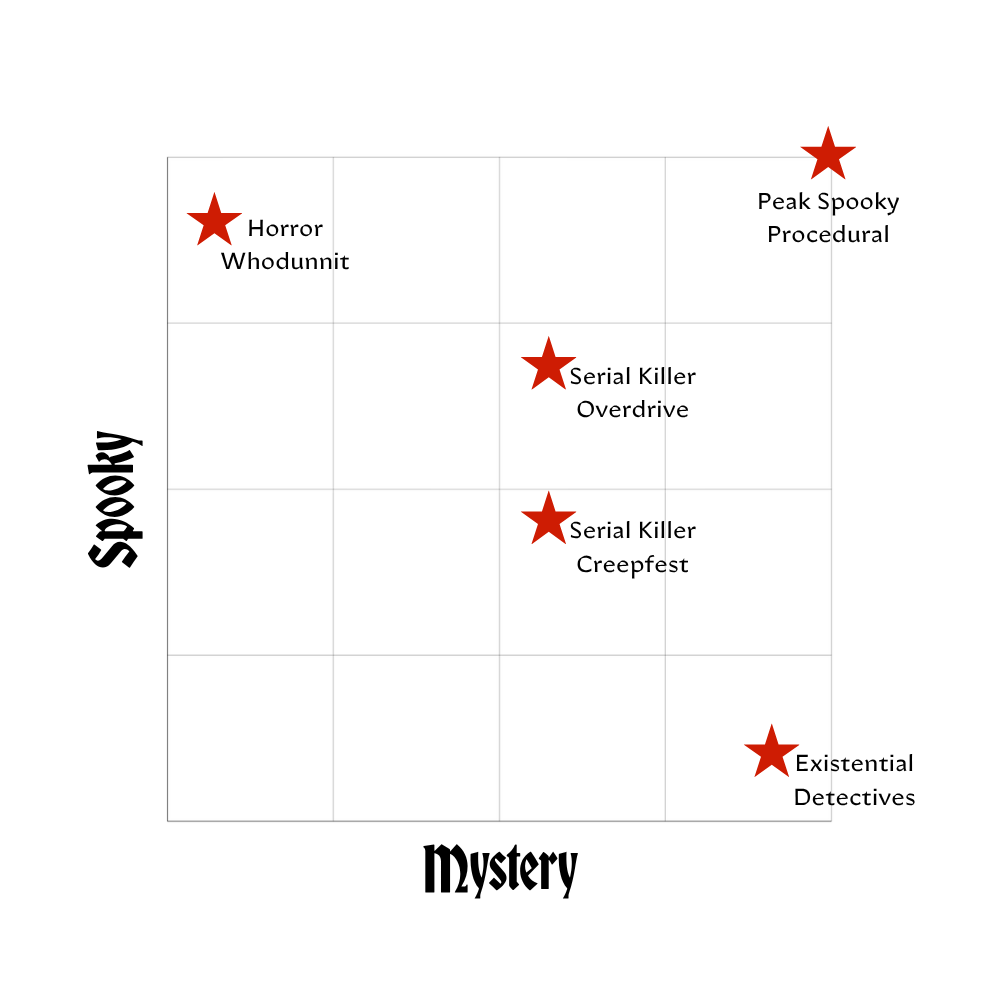
Horror Whodunnit
Spooky: High
Mystery: Low
Here you’ll find horror movies that keep the plot moving with a whodunnit, though really it’s all about the scares. Scream movies have their Ghostfaces masked for a reason: asking who’s behind that mask is part of how they keep you on your toes between kills. Clown in a Cornfield (both novel and film) follows this formula, too, mixing gory teen slasher with masked man mystery, keeping you guessing about who could possibly be behind the Frendo mask. Recent entry Hokum starts with the mystery of a missing bartender, though the spooky only really kicks in when the mystery is partially solved.
The heavy horror murder mystery is not going to rely much on typical mystery tropes, though there may be plenty of red herrings. The mystery is usually just the trigger of the story or the engine that keeps the plot running. At the end of the day, the scares are the main event.
Existential Detectives
Spooky: Low
Mystery: High
At the other end of the spectrum, when you dial the horror down and the mystery up, then you find yourself in what is mostly a typical procedural. There are usually cops or investigators, and the major concern is to solve some kind of mystery. The spooky here generally ends up being more tonal than anything else, and in this particular category, it’s mostly about big questions of the unknown.
A classic example is the first season of True Detective, a story about two cops who are technically trying to solve a murder, but spend much more of their time asking questions about the nature of time, existence, and evil. Or there’s Tana French’s debut novel, In the Woods, which has been flustering readers for many years with its refusal to provide a solution to a cold case, even when the protagonist is the primary witness. These stories try to consider bigger questions about human nature, like how In the Woods’ Rob actively holds himself back from learning the truth, or how True Detective’s Rust uses his work to detach from his own life after tragedy.
Expect some sad men who may or may not be aware of their personal shortcomings.
Serial Killer Creepfest
Spooky: Medium
Mystery: High
One of my hot takes is that all serial killer thrillers are basically supernatural horror stories. The killer moves too quickly, runs too fast, can be in every place at once, and knows every single weakness of the cop on their tail. But some serial killer stories lean into the spooky vibes harder, using the tension to keep you constantly on edge.
Think Silence of the Lambs, a movie that’s firmly part of the cultural canon at this point but that can give you the shivers even on your fifteenth viewing. Or Zodiac, where you’ll find yourself actually sweating as Jake Gyllenhaal goes into that basement. The killers in these stories, whether known or unknown, take on the same kind of eerie persona as a slasher villain. On top of the tension, there is an unnerving hint that things are never what they seem. These stories may not have traditional scares, but they can leave you more freaked out than if they did.
Serial Killer Overdrive
Spooky: High
Mystery: High
If the Serial Killer Creepfest can never involve any overtly supernatural element, there must be another category for those that can. After all, if a killer can seemingly be in two places at once, why not actually be in two places at once? If crimes seem almost inexplicable, why not make them actually inexplicable?
That is what is happening in Headlights by C.J. Leede. You get the best of both worlds here. An FBI agent tries to solve an impossible set of murders committed by people who have no recollection of committing them, who committed them for no reason. It is, simply, impossible. And quite quickly we realize that there simply must be a supernatural element here, but how are you going to explain that to the FBI? Headlights goes all in on the horror, with plenty of gore and big cosmic horror vibes. It’s hard to say whether it is more mystery or horror, because it has stomped all over the divide between them with a delicious squelch.
Another entry is Bat Eater and Other Names for Cora Zeng by Kylie Lee Baker, where the whole reason Cora gets into a serial killer’s sights is her job cleaning the crime scenes of his victims. Cora is also the one who sees the supernatural forces at play, the bats left in the gory remains, and the specter she’s convinced is following her. Filled with guts and ghosts in equal measure, not being sure if the ghouls are protectors or hunters or both keeps this read riveting.
Peak Spooky Procedural
Spooky: High
Mystery: High
The classic Spooky Procedural is, of course, The X-Files. It hits all the beats of a traditional procedural show in its monster-of-the-week episodes. The agents start with a mystery, they knock on doors, they ask questions, they take you through all the expected beats. Sometimes Scully gets her logical explanation, sometimes Mulder gets his aliens and creepy-crawlies. Mysteries like a tidy ending, but horror is much more happy to leave things unclear and unresolved, and there are times when True Detective’s Rust doesn’t sound all that different in his meditations on reality than Mulder does.
True Detective: Night Country, the show’s fourth season, breaks from previous seasons by fully embracing the supernatural and going Peak Spooky Procedural. It isn’t content to have vague references to The King in Yellow. Under Issa López’s direction, there are always ghosts, ghosts everywhere, ghosts inside every backstory and every subplot. In season one, there’s ambiguity around whether Rust saw something supernatural or just hallucinated it. In Night Country, we know that Navarro sees ghosts, and plenty of other characters do, too. It also manages to fit in one mystery after another, layered with some truly terrifying setpieces. It wants to solve mysteries and haunt your dreams.
A last new entry to this group is the new novel Absence by Andrew Dana Hudson. This is another very procedural story that has the supernatural baked in from the jump, and you get big speculative worldbuilding, too. In this near-future people suddenly “pop,” disappearing for no reason and without a trace. No one knows why and no one knows what happens to the people who leave. Harvey is a federal agent handling “Depopulation Affairs,” trying to turn some of the chaos of these disappearances into order, investigating and cataloging. But he and his partner are thrown when a woman reappears, claiming to have the truth of what really happens. It’s the kind of spooky world where you never really know what will happen, where there are big questions about human existence, and where we grapple with death and mortality in the way both horror and mystery ultimately do.
As genre divides get even more blurred, I suspect we’ll see even more mystery/horror mashups, and there are probably a few categories I haven’t found yet. If there’s something great I’ve left out, shout it in the comments.
Comments ()