
Dead Country: An Ode to Karen Russell's "Proving Up"
Karen Russell's Western Gothic tale is the scariest short story you've never read.

The Darker Times Subscriber Drive is alive undead! Help us hit 500 subscribers by August 14th so we can keep our bloody beating heart pumping – for significantly less than the cost of a new coffin, you, too, can count yourself amongst our commenter coven, our bloodcurdling book club, and our dreadful Discord. Join us today – or else.
We partner with Bookshop for all our book links. Any purchase you make through our links help support Darker Times.
Sometimes I dream that dark rains fall and my sisters rise out of the sod, as tall as the ten-foot wheat, shaking the midges and the dust from their tangled hair. Like rain, they thunder and moan. Their pale mouths open and they hiss. Their faces aren’t like any faces I know. Stay in the ground, I plead. Oh, god, please let only wheat rise up.
Spoilers follow for “Proving Up.”
I’m a firm believer that context is a hugely important determining factor in our relationship with any piece of art. I read “Proving Up” during what was probably the most frightening air travel experience of my life, on a work trip that took me from Missouri to Tennessee. A series of winter storms were rolling through the region and flights were being canceled left and right, but some enterprising air traffic controller saw an opening and gave us the all-clear. Moments after takeoff, I found myself wishing he hadn’t. I’m not generally an anxious flyer, but the turbulence was constant and terrifying, and my fellow passengers were not shy about expressing their own fear at top volume. In a pale attempt at emotional regulation, I opened the hardcover I’d picked up the day before, and it was there, at 36,000 feet, paralyzingly aware of my own mortality, that I met Miles Zegner.
Vampires in the Lemon Grove, published in 2013, is Karen Russell’s second short story collection. I had picked up a copy of her first collection, St. Lucy’s Home for Girls Raised by Wolves, from a table at the Union Square Barnes & Noble sometime around 2008, simply because I liked the title. I’ve been reading Russell’s fiction long enough to recognize the rhythm of her sentences by now, and I consider her to be one of the finest writers of short fiction currently working, in league with George Saunders and Ted Chiang. I was once so engrossed in her sui generis body-swap story “The Bad Graft” on the way to work that I missed my subway stop. So when I tell you that “Proving Up” is far and away my favorite of her tales, I hope you’ll understand what high praise that is.
 Karen Russell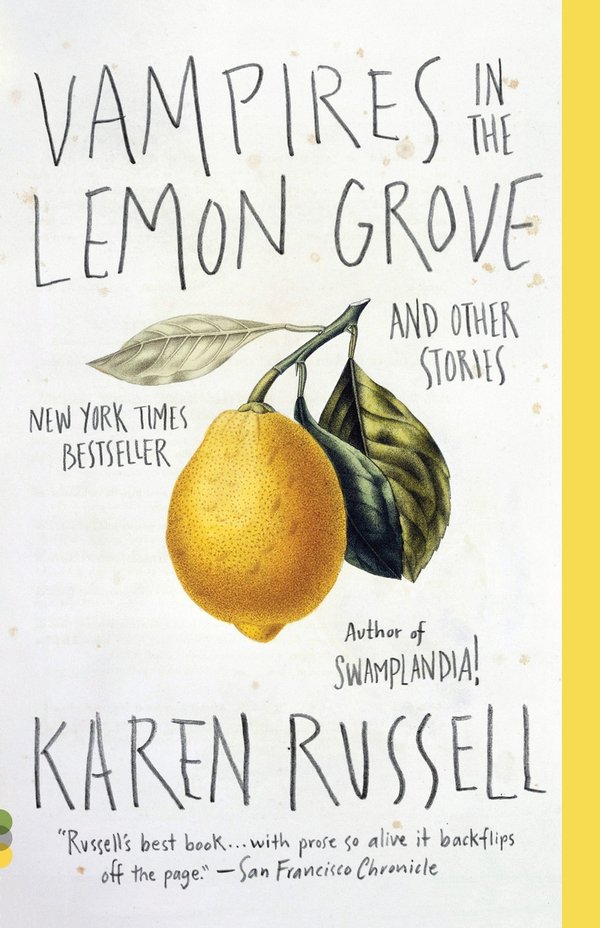
The setup is this: in the 1870s, the Zegner family is trying to “prove up”––to fulfill all the governmental requirements in order to be awarded legal ownership of their plot of dusty farmland in the punishing Nebraska landscape. The final hurdle––one that’s financially and logistically out of reach for many farmers––is that the farmers’ homes must have at least one glass window. Patriarch Johannes Zegner is in possession of such a window, one he generously lends out to other Hox River homesteaders who’ve come within spitting distance of earning their own titles. The Zegners have endured hardship upon hardship and watched many of their neighbors desert their own farms or die in the attempt to make a life in this unforgiving part of the world. Pa Zegner, however, is steadfast in his belief that once they own their land, their lives will change for the better.
On the day we meet Miles, age 11, he’s been charged by his father with safely shepherding the Window (always capitalized in the text) to two neighboring families in advance of the federal inspector’s visit and then bringing it safely home again. Eager to prove his manhood to his father and older brother, Miles applies himself to this task with earnest intensity, so fearful of accidentally breaking the fragile glass that he admits to himself he’d rather die than return home without the Window in one piece.
Not long after Miles has set out on horseback to cover the eighteen miles between his home and his neighbors’ farm, the clouds start to gather. When the rain begins to fall, Miles is overjoyed––the drought that has plagued them for years might finally break. But the rain turns almost immediately to snow as an October blizzard comes howling across the plains. The horse’s eyes freeze shut and, in a panic, it throws Miles and the Window and flees. Lost and freezing, Miles takes solace in the fact that the Window remains unbroken––until a tall, thin man covered in mud emerges from the high grass.
There’s a finely-honed instinct I’ve come to recognize in Russell’s writing that dictates how much information she feeds you, and at what pace. In “Proving Up,” a slow drip of details build and build until you find yourself stranded alone on a lifeless prairie, understanding that the Zegners are coming apart at the seams. Ma Zegner is wasting away both physically and psychologically––she’s preoccupied with tending the graves of the three daughters born and lost since the family’s arrival in Nebraska. Pa Zegner’s steadfast resolve will only hold so long, and his behavior has already turned strange. Of Peter, the eldest Zegner son, Miles simply says “Something is going wrong with my brother.”
By the time Miles meets the tall man, he knows, on some level, that all is lost. So when the man asks for the use of the Window for his own dugout, Miles follows him without making any conscious decision to do so.
A newcomer to the Hox River Settlement? (No, no, a little voice in me whispers, not new.) His eyes have the half-moon markings of a pronghorn antelope. He looks like he’s been awake for generations.”
I won’t spoil what follows––I really do urge you to seek this story out––but this is, to my mind, Russell’s finest work. The ability to sketch out a world like this in a slim twenty pages remains a marvel to me, and while Russell has always played in a fabulist sandbox, this is one of her few detours into pure horror. I wish she’d write more of it.
The central metaphor of “Proving Up” is one I think about often, and the reason I haven’t been able to shake the Zegners. Russell draws a deliberate, haunting parallel between two things we sow in the ground: seeds and corpses. The Zegners’ home is a dugout carved out of the sod landscape; Peter likens it to a grave. Huddled there under the earth, the Zegners themselves are planted in the soil, dormant seeds awaiting germination in the afterlife, preceded by their three dead daughters. And when a drunken Pa Zegner tells Miles the truth of the deserted farm from which he first took the Window, he mentions a curious line of crops that were growing there: hard, white sprouts poking out of the soil, growing in the form of a cross. By the time we realize what’s happening on the Hox River Settlement, the vertiginous sense of doom that dogged Miles across the prairie is on us too.
When you sow seeds in hostile soil, you may not like what you find come harvest time.


Comments ()