No One is Safe in Folk Horror
Liam Higginson's The Hill in the Dark Grove teaches us an important lesson: in the Welsh mountains, nobody can hear you scream.
If you start poking around you’ll find all sorts of people trying to define Folk Horror. Adam Scovell’s work, and his book Folk Horror: Hours Dreadful and Things Strange will inevitably pop up several times. Scovell’s definition of the genre requires:
- Landscape–place as more than setting but a kind of home for the force at play
- Isolation–extreme isolation rather than just simple social or physical
- Skewed belief systems and morality–as opposed to the typical beliefs of the time
- Happening–the inevitable fallout of these forces combined
Scovell doesn’t require the figure of an outsider, as so many current definitions do––the outsider is often a useful narrative entry point, a personification of the conflict between in and out, and a character who is either seduced by the isolated community and becomes one of them, or rejects them and is destroyed. But there are ways to tell a folk horror story effectively while removing one or more of these elements. As soon as you try to limit the ways folk horror can work, it will escape its bonds.
The definition of folk horror I’d like to use is a looser one. It generally involves the conflict of ancient versus modern. But there are many more conflicts and themes it can explore within that framework, such as Christian versus Pagan, urban versus rural, rich versus poor, nature versus man, global versus local, madness versus reason, chaos versus order, tradition versus change. You can even see masculine versus feminine, wisdom versus innocence, or age versus youth play out. folk horror is most often about a few of these conflicts bundled together and causing friction, the way opposites rub up against one another and cause sparks to fly.
One of the best works of folk horror this year is The Hill in the Dark Grove, the debut novel by Liam Higginson. From the moment you pick it up, this book screams folk horror, though it meets only one of Scovell’s requirements. It’s not just a great work within the genre but a reminder of how boundless it can be.
If we cling too tightly to genre definitions, then it follows that there are Ways to Survive folk horror. To be safe, you should be an established member of an isolated rural community; you should be in touch with the old ways; you should eschew modernity. Higginson’s central characters are Carwyn and Rhian, an older couple in rural Wales living on the sheep farm that’s been in Carwyn’s family for generations. Carwyn does his best to follow in the ways of his grandfather, “a country patriarch from an unbroken line of wry and humble folk, who left no mark to trace their stewardship of the land.” If anyone should be safe in folk horror, it is these two.
Carwyn does not worship ancient gods or participate in long-dead rituals. Nevertheless, the ancient is all around him, occupies much of his thoughts, and shapes his perspective on the world, as we discover in the first chapter when a small clay figurine is found in a stream. Aged and long worn down, no one can agree on what it was supposed to be or when it was made. Does it belong in a museum? Perhaps. But Carwyn keeps it in a biscuit tin, unwilling to part with it, connected to its mystery. Carwyn collects many strange, ancient, unidentifiable things.
“He was not a student of history. The odd-shaped stones were alien to him as letters in an unknown alphabet, but he felt, in some way, their significance. They seemed to him a proof of his belonging to the land–of the Welsh as the last true indigenous inhabitants of Britain. If Wales had been around a day, then the invaders were an eye-blink… there had been people like him living in these mountains for a hundred thousand years.”
Carwyn’s love of and respect for this ancient tradition does not keep him safe. The threat, at first, seems to be the modern world. A bad lambing season has Carwyn worried that he is finally going to lose the last bit of his family’s long-held land. Right on cue, the outsiders appear, a pair of English hikers, lost and injured. Carwyn considers the folkloric figure of the gwyllion as he follows the sound of their faraway cries. The gwyll would appear as a lost traveler who would then lure the helpful locals to their doom. As he leads the hikers back to his home for respite and rescue, he realizes that the hikers could just as easily see him as a gwyll figure, leading them off to an unknown destination. It’s a sly little turnabout, shifting Carwyn from potential victim to potential villain in this old bit of folklore, which is representative of what this novel does well. Folk horror is not just about simple tropes; it is the vastness of the ancient, unknowable world, the ever-changing wheel.
The outsiders recover and leave, the adventure nothing more than an anecdote. Instead it is Carwyn who gradually falls under a spell, after finding a head carved from stone in an long-unused field. His connection to the ancient does not make him immune, if anything it makes him more susceptible to the constant impulse to return to it.
 Liam Higginson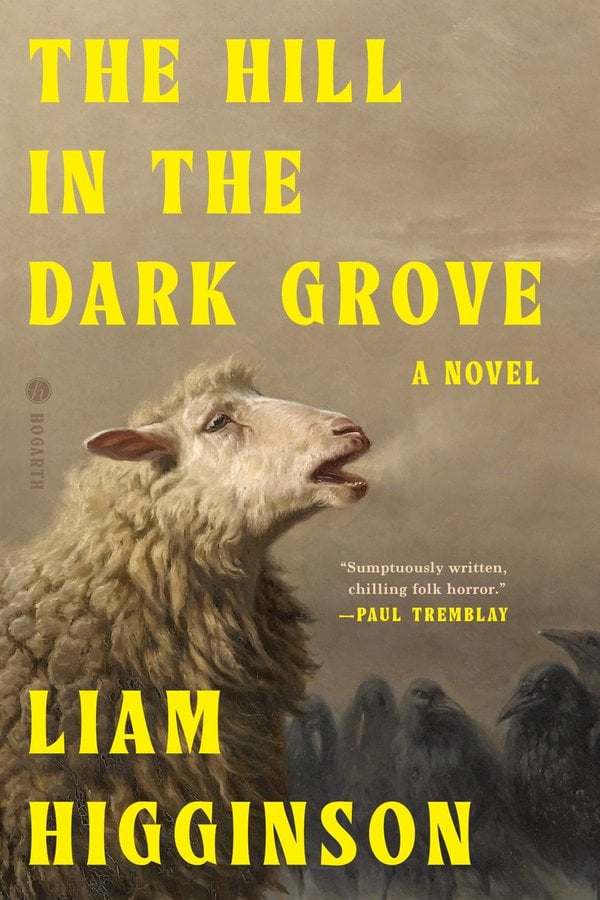
Shouldn’t Carwyn be safe? Shouldn’t it be the bumbling hikers who find themselves the victim of this ancient force? The simple version of folk horror would say so. But that is not what Higginson has in store. It is Carwyn, the man who’s lived his entire life on this land, the man who never left home, the man who still wants to keep old ways alive who is the target of this mysterious malevolence. It is as if Higginson wants to remind us that folk horror cannot be reduced to such straightforward logic. That any person at any time is vulnerable.
Each of the novel’s twelve chapters begins with an interlude set in this same spot on what is now Carwyn’s farm. We move backwards in time, from the 20th century to medieval days to the Stone Age. As we move through the centuries, we see this same force exert its influence. Sometimes it attacks the outsiders–the Cavaliers of the English Civil War, monks building churches, pillaging Celts. But most often it is the people of this place who engage with it. Sometimes it is a source of prosperity, a god to worship and sacrifice to who rewards them with bounty. Sometimes it is a source of vengeance, a channel for them to gain power over enemies who attempt conquest. But more often, the trouble stays local. No outsider would worry that their baby was a changeling.
At one point while planning this piece I sat down and listed every single conflict or theme I could think of in folk horror. When I sat down a short while later to take notes on these interlude chapters, I realized that, put together, they addressed every single one. No two are the same, not in time or action or result. Yet they all feel elemental, each its own pure and recognizable bit of folk horror flash fiction.
Help support Darker Times–become a paid subscriber today!
When we consider Carwyn’s story along with all of those who have gone before him, we cannot help but see Higginson’s expansive view of folk horror. The genre should not be reduced because the powers it addresses are mysterious, massive, beyond human understanding. Folk horror often feels closer to Cosmic Horror than to the everyday. It reminds us that this planet is not owned by people, that no matter how in touch with the world or our ancestors we are, that we are still part of something larger that we can never fully understand.
Is Carwyn a victim of this force because he doesn’t listen closely enough to the words of his ancestors? Because he doesn’t see his dreams as prophecy the way his grandmother did? Because he wanders into a field he was told not to go into as a child? Perhaps. But these are ordinary human failings. This is Carwyn’s only real flaw and it is the only one needed. The smiling boy about to be sacrificed in the 13th century hadn’t done anything wrong either.
We can enjoy the trope of the outsider without centering it. We don’t need to meet every element of Scovell’s definition to have an excellent work of folk horror. (The Hill in the Dark Grove arguably only has the first element of Landscape and none of the rest.) What folk horror requires is simply this conflict of the ancient and unknowable with the human and modern. Carwyn may not be modern based on an average person’s sensibilities, but compared to the hundreds of generations who came before him he is as modern as can be. And he is, ultimately, just a man, just a small being in a world he can never fully comprehend. Seeing the many ways folk horror can apply to the human condition is part of what makes it interesting. Folk horror can come from any culture or tradition, any people or time. It can come for any of us.

Comments ()