
Just Asking Questions: Ex-Mormons Talk About Heretic
A group of ex-Mormons talk about urban legends, religious representation, and more in the horror movie Heretic.
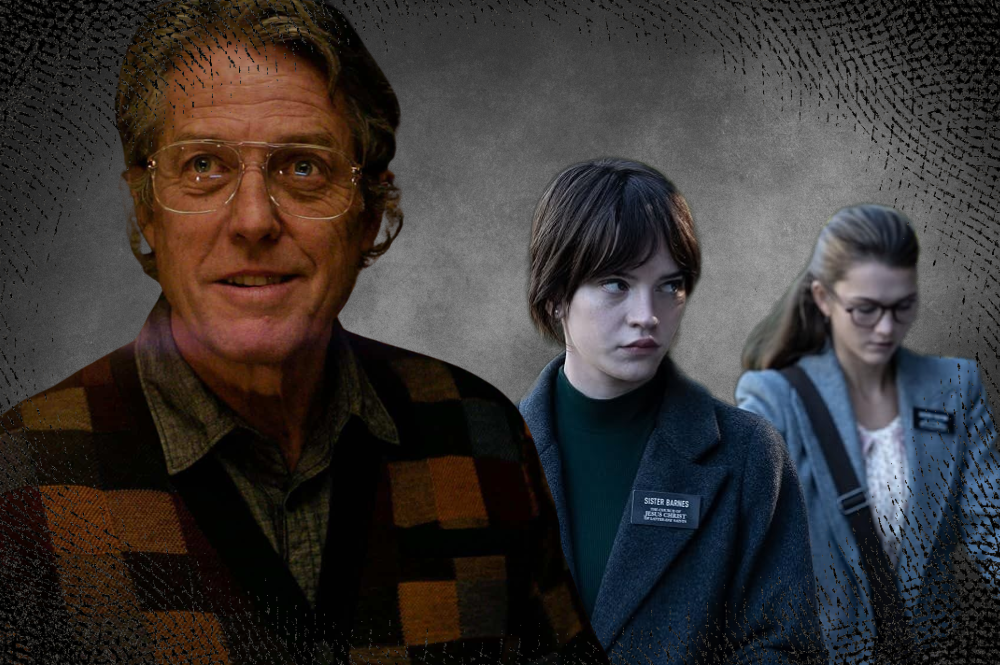
In 2024, Scott Beck and Bryan Woods, the writer-director team behind A Quiet Place once again made waves in the horror world with their film Heretic. Featuring an unusual set of main characters in two Mormon sister missionaries and perhaps the best of Hugh Grant’s over-the-top villain performances, it asks provocative questions about belief.
I grew up in the Mormon church, attended Brigham Young University, and was a believing member until my mid-20s, so Heretic immediately had my attention. I expected yet another story that doesn’t understand Mormons or their beliefs, but I was surprised to find that it has one of the most accurate and thoughtful considerations of Mormonism ever presented on screen.
For Darker Times I’ve gathered two of my favorite former Mormons, Kya and Blaine Foster, who graciously agreed to chat with me about it. Kya served in the Canada Montreal mission, and Blaine served in the Canada Halifax mission. (Kya and Blaine both transitioned after their missions, so Kya served as an elder and Blaine served as a sister, giving us a lot of interesting gender insights into the story!) Here, we fact check Heretic’s Mormon representation, explore Mormon urban legends, and share our vast experience with just-asking-questions guys like Grant’s villainous Mr. Reed.
Spoilers for Heretic follow. This interview has been edited for clarity and length.
 Topher Grace
Jessica: First, I wanted to get your initial takes on the movie. It was my second time watching Heretic, but you two had never seen it before. What did you think?
Blaine: It was not only my first time watching Heretic, but my first time watching any horror movie ever. Growing up as a Mormon, horror movies are rated R, and you don’t watch those. And then, I got too busy to watch a lot of movies, and there was never a Friday night where I thought, “What emotion do I want to feel on my one chance to watch a movie? Horror!”
Kya: It was my second real horror movie. I thought that it was very interesting that they managed to create this horror and tension with only the circumstances, the music, and the acting. It wasn’t reliant on the gore and gross-out stuff.
Jessica: One of the things I really wanted to talk about was that being a missionary is actually really dangerous. Mormons know this, but in the outside world, everyone thinks of missionaries as a funny little weird phenomenon that you run into on the street sometimes. I think it’s interesting that this film takes this thing that we know and suddenly makes the rest of the audience realize, “Wait, this is super dangerous; why are they doing that?” You’re young, you don’t have a support system, and you’re engaging with strangers constantly, what more dangerous thing can you do?
Kya: One of the first thoughts I had about the movie was that this had to be sister missionaries. You simply could not make this movie with elders, if for no other reason than elders would not pick up on the subtle danger signs until they were literally standing over the dead body of the person who ate the pie. That is when elders might realize that there was danger. [Context from Jessica: Female missionaries are referred to as sisters and male missionaries are referred to as elders.]
I was an elder, so I had a very different experience of the danger, but on the occasion where someone would invite us in, and I started picking up the creepy vibe, if they offered me something to drink I would say no. I don’t know if I genuinely believe you’re gonna try and drug me or poison me, but you are giving me a vibe, and I am going to do what I can to ensure my and my companion’s safety with that vibe. I know a story from my home stake [JW: a stake is a local collection of Mormon congregations] of a guy who while he was on his mission he would send his weekly letters home and one week he sends his letter and it’s very normal, we talked to these people, blah blah blah, and then his dad gets a separate email from him that starts with the phrase in all caps “DO NOT SHOW THIS TO MOM,” and then he proceeded to tell his dad that he and his companion had been mugged at gunpoint. I've heard more stories like that from elders; whereas I've heard more stories of a creepy guy who made it hard for us to leave his house from sisters.
Blaine: There was this area of rural Maine in my mission where they wouldn’t send sisters there, they’d only send elders. Because once the elders had been chased off a porch with a weapon. And my thought was, why are we sending anyone there then? Seems bad for the elders also!
Kya: I think going back to what you said about other people not really recognizing the inherent danger. I think about seeing a post on Twitter or Reddit where someone says, The Mormons keep knocking on my door like every week, and one of the first responses is always, Just open the door naked and they won’t bother you anymore. What other situation would it be so normal to casually suggest sexual assault?
Blaine: So many people on my mission had someone open the door naked to the point where I'm surprised that it never happened to me.
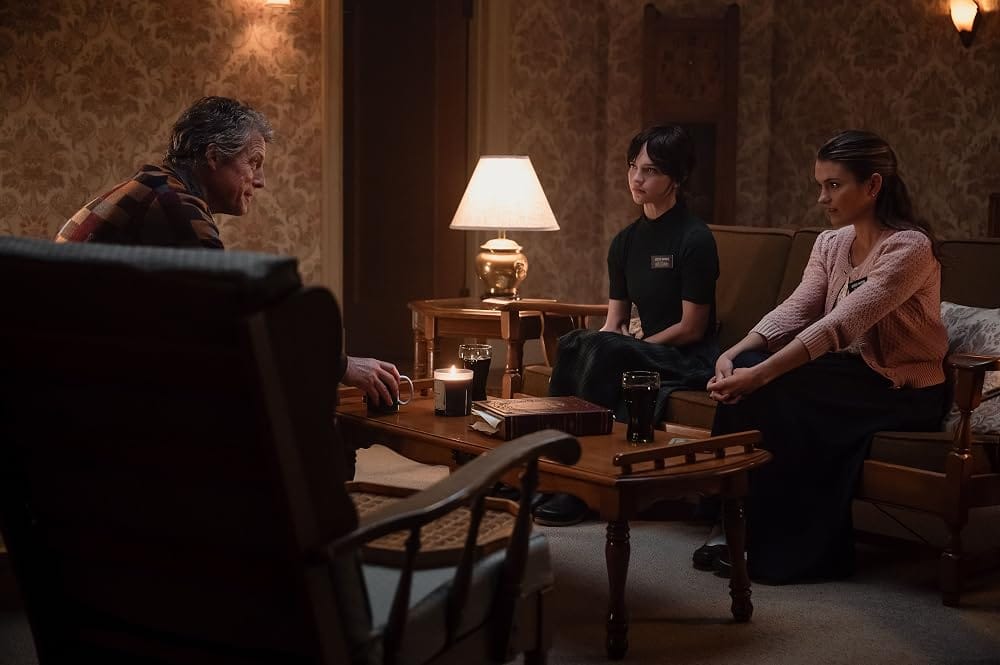
Jessica: I want to talk about Mormon urban legends and how many of them are about missions and missionaries. Mormonism is so predisposed to create urban legends: you don’t have a pastor or a priest who always gives a sermon, instead we all take turns teaching each other. So you share your story and then it gets passed on–like Kya, you just shared a story that someone else told you. They get passed around so much. People have heard the same legends about missionaries no matter where you live or how old you are. I’m curious if there were any in particular that you heard.
Blaine: I seem to recall this as a fact, but it could be a Mormon legend, that The Texas Chainsaw Massacre was inspired by an attack on Mormon elder missionaries. [JW: This was a real crime but it is unrelated to the film, so it is indeed a legend.]
Kya: Everything that happens in [Heretic], the other members of that mission would turn this into a legend. And they’d say the reason those sisters got attacked and Sister Barnes died was because they didn’t follow a specific rule. I thought of a story I had heard of some missionaries in Los Angeles, and there’s a rule for missionaries about not going swimming or going in the water.
Blaine: The Devil has control of the water.
Kya: It’s P-Day [JW: A missionary's day off] and the elders are hanging out on the beach and one of the elders decides I'm going to take my shoes off and just walk in the shallows to cool my feet. And then suddenly a wave comes up, knocks the elder over, and pulls him out to sea and he dies.
Jessica: I have heard the same thing, except I heard standing on an overlook over the ocean.
Kya: You mentioned Mormon urban legends, and Mormons being uniquely predisposed, it goes all the way back especially within missionary culture. "Bigfoot is Cain" is literally a Mormon missionary legend. Because David W. Patten was a missionary, and he was going through the woods when suddenly Bigfoot showed up and started chatting him up.
Blaine: He’s like, I’m Cain! There is also the story of some secret network of apostate missionaries. They dye their garments black or they cut a hole in the shoulder of their garments so you can put your hand on someone’s shoulder and feel the hole in the right place. I always wondered, They dyed their garments black but they were wearing white shirts?
Jessica: This legend of a secret society of Satan-worshipping elders is one of the ones that I ran into in my research. Apparently this is a very common one, and it usually ends with the mission all together for a conference, a general authority–usually apparently it’s Elder Holland–is there–
Kya: I’ve always heard Elder Bednar.
Jessica: The specific person changes over time. And the general authority says to one half of the room, You guys are good; go on, you good and faithful servants. Then to the other side he says, You guys are all going home.
Kya: A sort of interesting thing is we had that legend in our mission but it was based on something that actually happened. There was no real quorum of the twelve apostates or black garments, but there was this friction between older missionaries and the new mission president because of this sudden shift in culture that came when a new mission president arrived and cracked down on the rules. They called it the Zone Leader Riot, these elders walked out of Zone Conference. The mission president paired all the walkouts with more obedient missionaries to work through it.
Blaine: It does speak to how the companionship system is partly about having a snitch with you at all times.
Jessica: Mormonism loves a narc.
Blaine: If Heretic really happened, it would definitely become a Mormon legend, but it wouldn’t be the same as the movie. When they have to choose between the Belief and Disbelief doors, Sister Barnes says No, we are going to be faithful. We are going to go through the Belief door. It subverts the style of a Mormon legend since she gets killed, and Sister Paxton, who wanted to choose the Disbelief door, is the one who survives.
Jessica: Mormon urban legends are either inspirational about a miracle that happens or exist to say "don’t break the rules because this bad thing will happen."
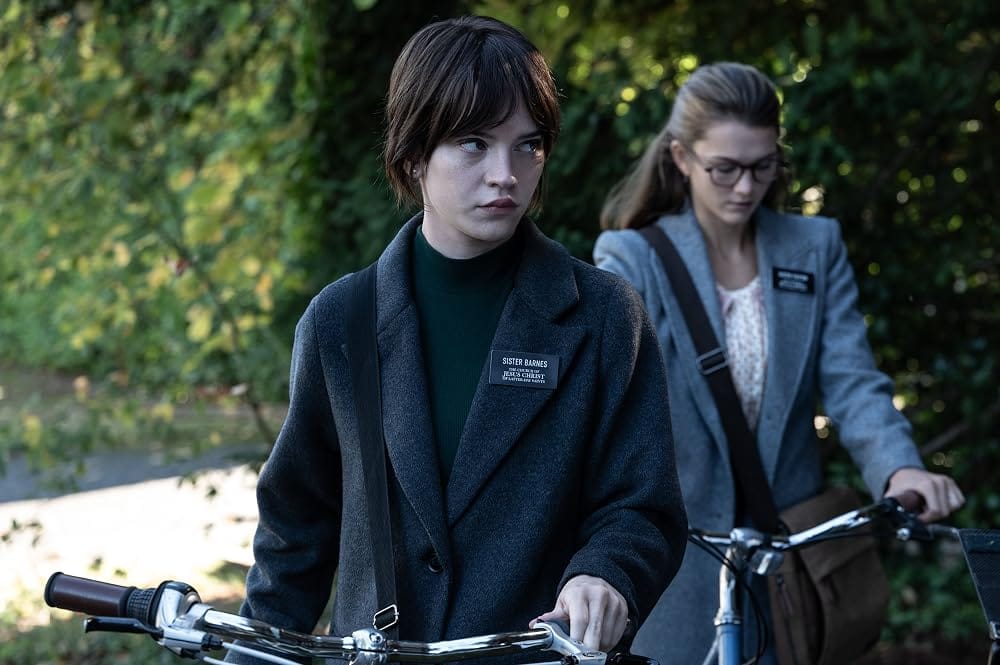
Blaine: There is the rule about how if you’re two sisters you’re not supposed to go in a house that’s just a man, and vice versa for elders. That almost made the movie feel like the kind of urban legend you hear on a mission. This is a horror story that missionaries tell each other, and in that version of the horror story, it happened because you broke the rules. The horror story is a morality tale. As the movie goes on and as the danger signals keep getting louder, as a Mormon woman, you’re so conditioned to be nice. They didn’t want to say anything to offend him. And they kept trying to placate him by saying, You are so smart and insightful, and you’ve thought of these things that we’ve never thought of, and you’ve given us a lot to think about, and we really appreciate it, when what they really want to say is You’re creeping me out. Let me out of here.
Jessica: I can’t imagine finding a character to put on screen who is gonna be more likely to placate and fawn than a Mormon sister missionary. You’ve got the woman piece of it, then the Mormon piece of it, and then you add the sister missionary piece of it. This is peak placating. And I felt so deeply the recognition of watching their faces when they're saying the opposite of what they feel.
One thing I wanted to come back to is the depiction of Mormonism in the film. When I think about seeing Mormons depicted in media, it is always as an Other. It’s always a Them, not an Us. The Mormons are there to be a foil, they exist the way Ned Flanders exists in The Simpsons. You just bring him in when you want to get this extreme reaction or this extreme juxtaposition. Heretic is the only art I can think of that explicitly positions Mormons as Us. It says Mormons are just the same as all other religions, which to a lot of other religious people who are not Mormon would be radical, maybe even blasphemous to say.
Kya: I was really impressed with the sisters' portrayal. Those actresses, I could have believed that both of them had served missions.
Jessica: They both have Mormon backgrounds, apparently. I think they just nail it. The thing that most bugged me about the accuracy of Mormonism in this film was Sister Barnes’ bangs. I just couldn’t imagine a sister missionary having bangs that cool.
Blaine: As a sister missionary, we would get pulled into these meetings with the mission president’s wife, and she would give us all these extra things in the dress code to make us look cooler. They didn’t want us to look frumpy and weird. They didn’t want us to look like religious fundamentalists. They wanted us to look normal and cool. There was quite a bit of pressure to wear a certain amount of makeup, to wear nail polish. But the nail polish shouldn’t be bright and gaudy, it should be a nice neutral color. And when you wear makeup, no red lipstick. And your hair should be done nice. I remember sitting there thinking, And then I’m gonna go back to Newfoundland, and I’m gonna put on my rubber boots with my skirt, and I’m gonna go outside, and it’s going to be sleeting with high winds, and the makeup’s gonna get smeared all over my face, and my hair will get smushed under a bike helmet. I don’t know what we’re trying to do here. To some extent there’s pressure not only on femininity but on modernity and looking cool.
Jessica: That’s so interesting! I’m showing my age, because during my time when the mission age for sisters was older, the stereotype was that they were all the frumpy girls who couldn’t get married. I did think casting Topher Grace as a Mormon was inspired. I feel like he has Mormon Face.
Kya & Blaine: He does have Mormon Face.
Blaine: One thing that pulled me out of the movie was that I was not very good at being a sister missionary, really. My mission president said once that we should be warm, genuine, and friendly. And I said, What do we do if we’re genuinely not warm and friendly?, and he got mad at me. I was not trying to be a smart aleck. This was a sincere question. I'm genuinely not a warm and friendly person. At least not in the way that sister missionaries are supposed to perform this hyperfemininity. I was getting pulled out of the movie thinking I would be arguing with Hugh Grant so hard by this point. Oh my god the cycle of apostasy and restorations? Is that what you're presenting to us? I’ve already spent 18 months being lectured by this kind of guy. I don’t know why I'm voluntarily being lectured by this guy again in the middle of a Sunday on my TV.
Jessica: That guy who just loves to argue with you about religion or to try and ask you some gotcha question about your religion. Every Mormon has had this their whole lives. People were asking me about polygamy in elementary school.
Kya: How many moms do you have? I had a bit I would do in middle and high school when kids would find out I was Mormon and ask how many moms I had, I would say, Well I have one biological mom but then there’s– and I would just start listing off the Relief Society and they would be like, Are you serious? And I'd be like, No!
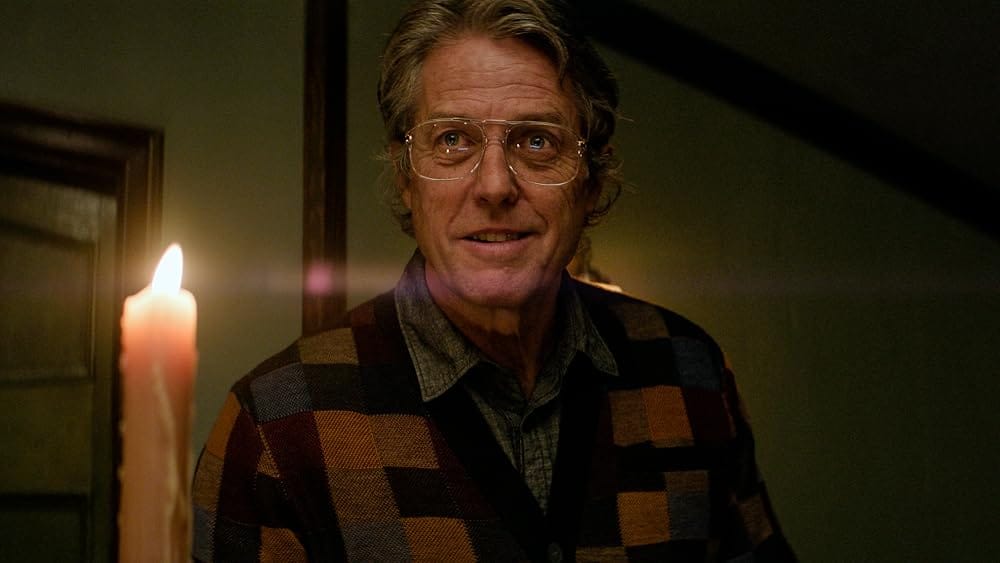
Blaine: Most of the big questions in life, the reason that no religion has produced a perfectly satisfying answer that convinces everyone and then everyone follows that religion, is that these are the questions that don’t have answers. The problem of pain: why is there pain in the world? It doesn’t matter what answer you come up with. It’s not going to stop you from feeling that deep pain. No matter how you come up with the doctrine, everyone is gonna have these moments in life where it doesn’t feel like enough.
That’s actually where the social value of religion comes in, is in the rituals. To a certain extent, performing rituals gives us comfort regardless of the meaning behind the ritual. And having the community gives us comfort regardless of the origin of the community. So at that moment when Sister Paxton prays that she’s grateful for her trials—that she’s most certainly not grateful for!—it’s because the ritual is comforting regardless of the meaning of the words. That’s exactly her point about the prayer study. It’s that religion and the community build with the lived experience something comforting even if you don’t believe it. Whereas Hugh Grant’s alternative to religion is isolating you from everyone, depriving you of every possible comfort, keeping you freezing and naked in a basement, and starving you. I don’t think you’re making the point against religion you think you are, Hugh Grant!
At the same time, that is what makes it so painful if you come up in a religion and then you can’t be part of that community anymore. As transgender people, you had this community that did all of these things and maybe you believed it and maybe you didn’t, but now you’re forcibly expelled from that, the rituals and the shared experience. In that sense, that’s where it comes back to the idea that religion is about control. There’s this book Against the Romance of Community by Miranda Joseph, and she argues that in all communities, even communities that are supposedly founded on progressive ideas, the concept of community can be wielded in a way that is conservative and controlling. Hugh Grant exerts his control through isolation, and I would argue that Mormonism exerts control through community and through the things you have to do to remain part of it.
I think it makes us uncomfortable that people can be presented with the same information and come away with two very different conclusions. Where Sister Paxton says, There’s this study that shows prayer doesn’t affect outcomes, but I'm going to pray anyway because I find it comforting. And then there’s someone else who will see the study that prayer doesn’t affect outcomes, and it’s very painful and disillusioning for them, and they conclude that there’s no God and prayer is pointless. What we as a society struggle with is those two reactions are both perfectly reasonable. And you don’t have to design maze traps to validate your own reaction to every crisis.
Kya: Like sorry you had a faith crisis, Hugh Grant. Sorry you decided to study theology in college and it made you sad.
Blaine: Maybe just get on ex-mo Reddit and stop torturing women.
Jessica: Start a podcast, Hugh Grant. The one really important takeaway from the movie besides offering good Mormon representation is that it’s saying that the guy who is “just asking questions” is actually a sadist.
Kya: It’s a critique of “just asking questions” but also it is saying, Hey you should consider your beliefs, and why you believe things, and whether it’s just because it’s what you’ve been told all your life or not, but don’t do that because Hugh Grant or someone like him told you to.


Comments ()