
The Work of Art in the Age of Mechanical Hallucination
Or, why I stopped worrying and learned to love Walter Benjamin in the Backrooms.
One of the requirements for my English Lit major in college was that I had to take at least one semester of critical theory. At the time, I couldn’t imagine anything more unpleasant, and I put off enrolling in a suitable class until my senior year. When I finally caved, I chose a seminar on Walter Benjamin, primarily because my best friend was taking it and I thought she’d make it more bearable. If I could tell 21 year-old Emily she’d be voluntarily incorporating Benjamin into her cultural criticism two decades later, I think she’d probably slap me right across the face, but here we are.
I find myself thinking about Benjamin far more than I ever expected, and particularly as I watched Kane Parsons’ Backrooms. If you know anything of Benjamin’s work, it’s probably “The Work of Art in the Age of Mechanical Reproduction,” his foundational Marxist examination of the function and place of art in a capitalist society; he posits, among other things, that an original work of art has an “aura” which reproductions, no matter how skilled, can never capture. Aura is derived from several factors, including authenticity and the artwork’s location both in physical space and in cultural context. (One must imagine Walter Benjamin, wherever he is now, absolutely tearing his hair out over the rise of AI slop.)
Benjamin’s other major work was his unfinished Arcades Project, a meandering, fascinating series of writings on the urban life of Paris in the 1920s and 30s. The arcades of the title are covered pedestrian walkways lined with shops, an architectural form which Benjamin found particularly meaningful as a lens through which to view class, capital, and the intersections between private and public spheres. One also wonders what he’d make of Kane Parson’s feature debut.
I don’t know if Kane Parsons has read any Benjamin, but these concepts have a way of trickling out into the pop cultural groundwater via osmosis. I entered the theater not expecting to encounter such a thematically rich film, especially from such a young director. What I found lit my brain up with links to cultural predecessors and reference points and artistic modes. What’s stuck with me the most, especially after a recent second viewing, is the film’s approach to capitalism, alienation, and replication.
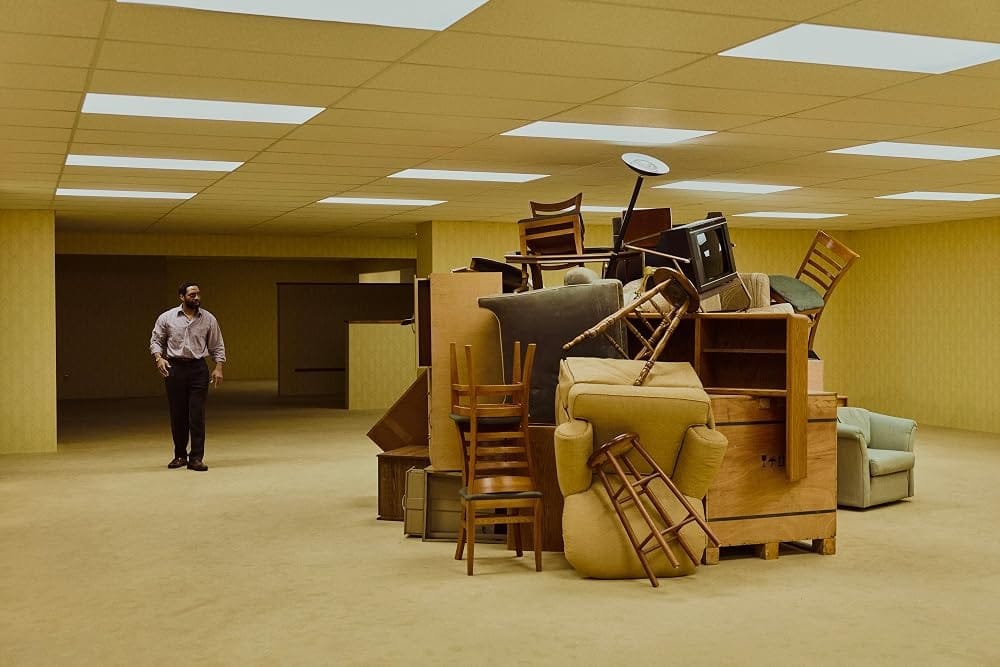
That the Backrooms are a manifestation of capitalist spaces and littered with the detritus of business is intrinsic to their uncanny atmosphere. (Remember, too, that in Freud’s definition, the German word for uncanny is unheimlich–literally, “unhomely.”) An office building has no soul, no center. It is not a place for humans to live or play or love or feel; it is a space designed solely for the machinery of capital, where human needs come second. Furniture, cardboard cutouts, and advertisements, ripped from their normal context, take on a threatening air. The absence of people in what should be a populated space makes it all the more terrifying when humans who find their way inside hear something else moving around corners, unseen. The Backrooms are corporate alienation taken to a fantastical extreme. There is nothing comforting here.
Shira Chess, in her excellent essay connecting Backrooms to its literary Gothic forbears, explains it thus:
“Like the traditional Gothic, the Institutional Gothic involves uncanny spaces, malevolent forces, and overwhelming discomfort related to spatiality and power. But where the traditional Gothic is dark and looming with ornate architecture, the Institutional Gothic occurs in winding or otherwise empty office spaces, consumed by machine-made mundanity and the unforgiving gaze of noisy overhead fluorescent lighting. The antagonists, once bloodthirsty lords, are instead soulless corporations… Taken together, the Institutional Gothic transforms a genre once fueled by phantasmal terror into the familiar, worldly dread of workplace alienation.”
Contemporary online culture’s version of the liminal aesthetic has been having a moment recently, between Backrooms, Alexander Ullom’s It Ends, Genki Kawamura’s Exit 8, and even Kyle Edward Ball’s divisive Skinamarink. That many of these creators are either Gen Z or younger Millennials should not go unremarked; nor should the fact that the spaces in which these stories take place are spaces that were largely created by older generations. It’s an artistic trend that reflects our fractured reality: the world we were promised by our parents’ generation isn’t really for us anymore. Many younger people feel stuck, trapped in an economic and social loop from which there is no apparent escape. “Liminal” in its original context meant a transitional space, but now the meaning has slipped a little, become something closer to “uncanny”: a place that isn’t for you. A place that, maybe, isn’t for anyone.
 Jessica Woodbury
Parsons’ film underlines this sense that the Backrooms are not made for humans by showing us humanlike figures wandering the space, mobile but nonverbal. A character in the movie suggests that the objects and “people” that populate the Backrooms are “memories,” or rather, misremembered versions of the people who’ve entered the space and the baggage, psychic and otherwise, they brought with them. (This is perhaps the most human aspect of the Backrooms; neuroscientific research has demonstrated that each time we recall a memory, we alter it.)
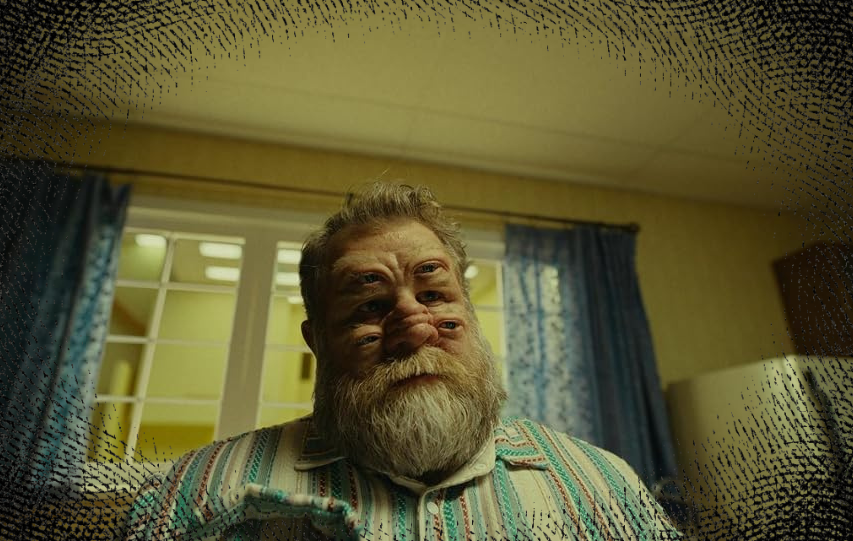
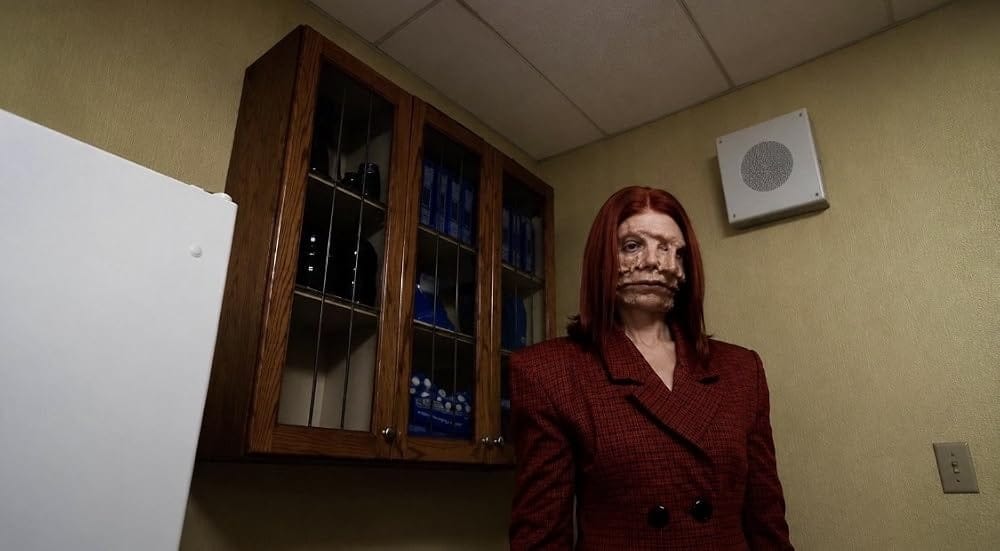
When Clark (Chiwetel Ejiofor) traps his therapist Mary (Renate Reinsve) in a kitchen-like space, he’s gathered several of these un-people. Their faces and bodies are stutters, like multiple still images taken from a video and superimposed over each other, or like AI hallucinations of people with too many eyes or mouths. Clark demonstrates their unhumanity by violently stabbing one of them and digging an apparently edible chunk of goo out of the chest of another. Neither figure reacts; they’re empty, void of consciousness. Put another way, each human is a work of art, and when reproduced, stripped of their aura, their authenticity.
But Clark doesn’t care. He’s an angry, damaged man who can’t accept his own responsibility for the dissolution of his marriage, which has led to him sleeping in the furniture store he owns (talk about unhomely). The Backrooms become a psychological trap that he perceives as freedom: in here, nothing challenges his bitterness toward the rest of the world. In here, he can succumb to the loop he’s found himself trapped in and never has to face the difficult work of owning up to his own culpability in his loneliness and rage.
Clark: “I don’t think I want to change.”
Mary: “Then don’t.”
Clark: “I like it in here. For the first time in a long time, I feel like I'm... Like I'm right where I'm supposed to be.”
Clark, who has left his sanity behind, experiences this as relief; Mary and the audience, meanwhile, can see it for what it is: surrender. He wants to live out the rest of his life in the comfort zone of this behavioral cycle, in a world of reproductions devoid of authenticity or cultural context, free of human judgment. Aura does not exist in the Backrooms, nor does humanity.
Because Clark belongs nowhere, nowhere is where he belongs.



Comments ()