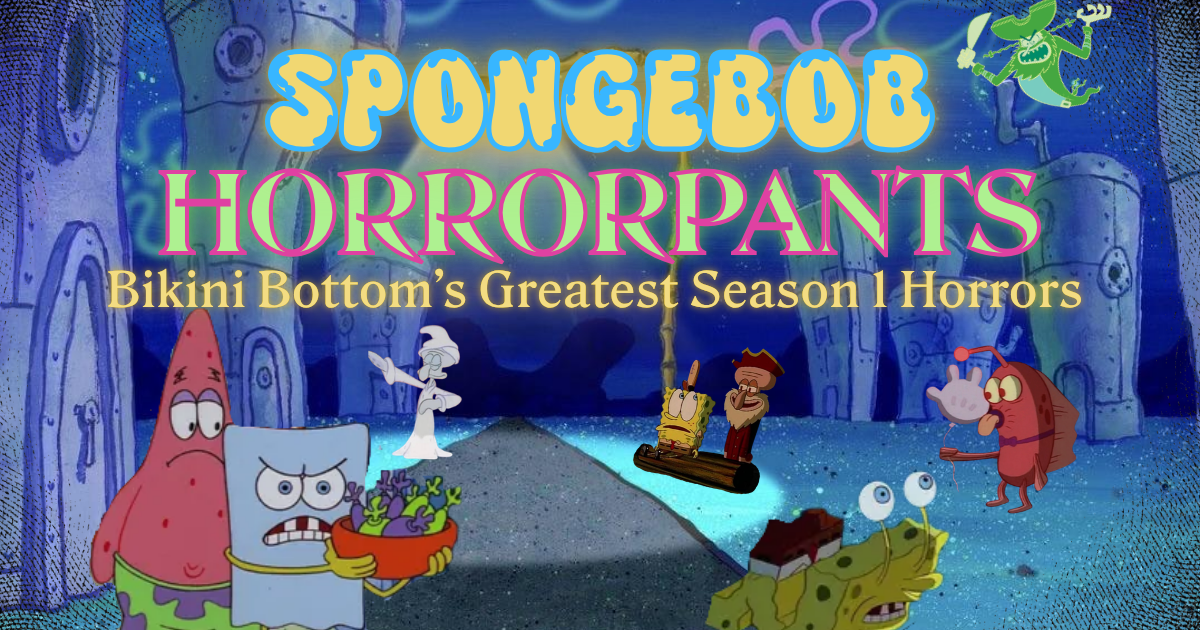
SpongeBob HorrorPants: Diving into Bikini Bottom’s Greatest Horrors from Season One (1999 - 2001)
Taking a look at the show that probably shaped my strange horror heart
We partner with Bookshop for all our book links. Any purchase you make through our links help support Darker Times.
One of Nickelodeon’s most successful franchises, SpongeBob SquarePants stands as a pillar of pop culture in my Gen-Z heart. A nautical sponge, SpongeBob SquarePants goes about his various adventures in the underwater town of Bikini Bottom. Leading a fairly innocuous life, he works as a fry cook at the Krusty Krab, he goes jellyfishing with his best friend Patrick Star (a starfish who lives under a literal rock), he attends boating school, and he cares for his pet snail, Gary.
A pretty harmless life, right?
Wrong!
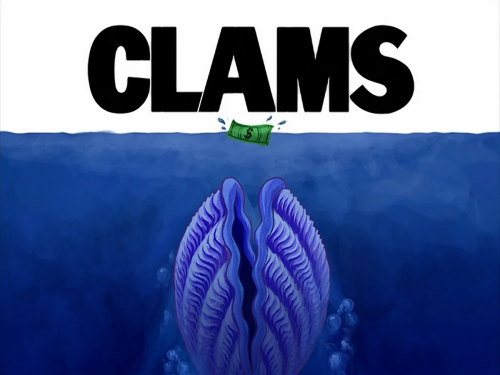
Horror thrives in Bikini Bottom, a fact I hadn’t considered until rewatching the season 3 episode, “Clams.” As a kid, I was unable to clock the repeated nods to Steven Spielberg’s iconic horror classic, Jaws, as I hadn’t been exposed to such cinematic greatness just yet. But as an adult, one look at the episode’s title card set my horror brain ablaze and left me wondering what other forms of horror this children’s cartoon possessed.
Armed with a Paramount+ subscription and free will, I decided to revisit SpongeBob through more mature, horror-focused eyes, and my findings were nothing short of enthralling. One of the greatest revelations was that many of the fears and anxieties that plague my adulthood were actually very clearly depicted in the landscape of Bikini Bottom, a harbinger of things to come. Multiple episodes are downright terrifying for the normal horror genre reasons (think monsters, crimes, etc.), but also for deeper, existential reasons as well.
Thus, I present a breakdown of the episodes from season one that screamed horror. A quick disclaimer: SpongeBob is a long-running series with over 300 episodes (the IMDb page for this show is stunning). This piece will focus on the episodes that resonated personally, and if there’s an interest, I’ll move onto other seasons!
Season One Horrors: Are You Ready, Kids?!
May of 1999 marked the beginning of SpongeBob with its first season containing 20 episodes each consisting of two segments. Creator Stephen Hillenburg was actually a marine biologist who eventually found his way to animation and the arts, previously working on Rocko’s Modern Life before moving onto building the rich landscape of Bikini Bottom.
The horror found in this season tends to vary from easily recognized scares to deeply existential dread that stands the test of time with focuses on death, extreme body horror, isolation, and more.
Squidward, The Unfriendly Ghost - Season One, Episode 11
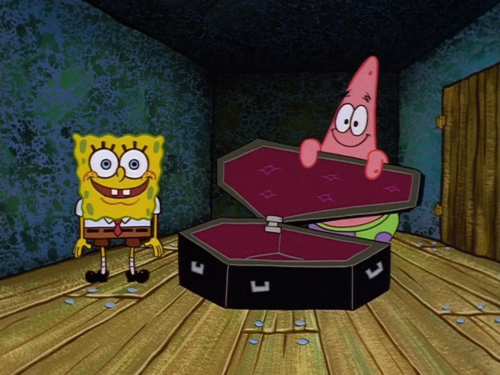
Squidward works to achieve artistic greatness by sculpting a replica of himself when SpongeBob and Patrick’s antics destroy his creation. Believing that they have killed Squidward, SpongeBob and Patrick descend into mania while Squidward seizes the opportunity to “haunt” them. Of course, Squidward takes things too far, having SpongeBob and Patrick complete increasingly cumbersome tasks, taking advantage of their guilt. This leads SpongeBob and Patrick to believe that the only way to help ghostly-Squidward is to put his ghost to rest.
The horror of this episode originates in one of those “blink and you’ll miss it” scenes: when SpongeBob and Patrick discover Squidward’s “body” (his broken sculpture). Immediately, the two try to frantically reassemble Squidward into the shape of the neighbor they know and love. It’s a very quick clip, one that you’d glance over, but observing this scene through a lens of horror, there is a unique, distraught note of distress that absolutely sings. Spongebob and Patrick’s anguish over their presumably lethal error inspires profound dread as the proverbial toothpaste can’t be put back in the tube, or rather, the squid can’t be put back together again. Harrowing. And reflecting on SpongeBob and Patrick’s reaction to this mishap, I can’t help but think of themes of wishing the dead back to life as seen in Pet Semetary (both the film and book). And we all know how that ends.
For Squidward’s part, he must contend with his own mortality that is brought to life through seeing his own gravestone and coffin when Spongebob and Patrick try to lay him to rest. What was once a joke becomes a dejected reality that is deeply bleak and unfathomable. This is the kind of bleak scenario, this contention with death, that the horror genre thrives in, kind of like Bruce Willis’ character at the end of The Sixth Sense or even the entirety of the Final Destination franchise. As in Squidward’s case with this episode, death is something that is made very real in an existential fashion that proves to be no laughing matter.
While we can all accept that we won’t live forever, being confronted with such artifacts of death (like coffins and grave stones with our names on them) feels like an escalation of this reckoning of fragile humanity. One wrong move, and it really could be the end of the line for us. The Dorians by Nick Cutter makes for a fantastic companion read concerning these exact themes.
Scaredy Pants/I Was a Teenage Gary - Season One, Episode 13
Airing for Halloween in 1999, “Scaredy Pants” and “I Was a Teenage Gary” are two episodes that did frighten me as a child and further disturbed me as an adult.
“Scaredy Pants” opens to a Halloween landscape with SpongeBob working the closing shift at the Krusty Krab. Mister Krabs tells a fireside scary story of the Flying Dutchman, a ghostly figure who comes to Bikini Bottom to steal everyone’s souls. Mister Krabs does this whilst holding up a pickle from a Krabby Patty, leading SpongeBob to believe souls look like pickles. And in a line I still quote at least twice a week, we see Squidward jumpscare an already terrified SpongeBob, saying, “I’ve come for your pickle.”
Priceless.
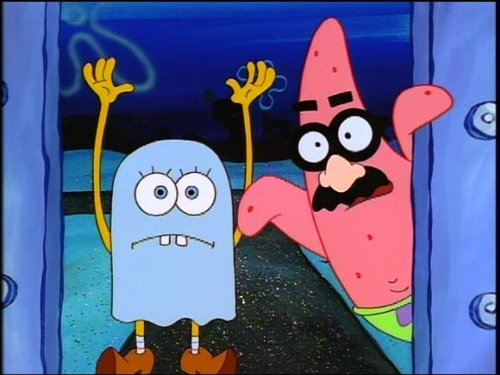
Instead of humor, SpongeBob finds the encounter frightening, earning the name SpongeBob ScaredyPants. Determined to prove himself brave, he enlists the help of Patrick to craft a costume to wear to Mister Krabs’ Halloween Party. Donning a sheet would transform anyone else into a ghost, but this doesn’t quite work for SpongeBob with his square-shaped body.
Thus, Patrick and SpongeBob devise a plan to make SpongeBob “round.” SpongBob’s desire to be morphed and molded into a presentable shape harkens similar themes from The Substance (2024) where body morphing for social acceptance results in a very twisted, very unsettling outcome. We see a montage of Patrick’s actions (taking literal clippers to SpongeBob’s body) to get him to fit into a traditional ghostly shape. But we don’t see what’s under the sheet, a SpongeBob that’s just a spinal column and brain. The final frames of the episode show SpongeBob in this way, instilling irrefutable body horror. This is the kind of final-reveal that feels connected to body shocks in films like Tusk (2014), a grotesque final punch that ensures a lasting impression. Together, these extreme self-sacrifices and drastic changes signify a robust sense of body horror, even within a children’s cartoon. youthjuice by E.K. Sathue pairs very well with this brand of body modification horror.
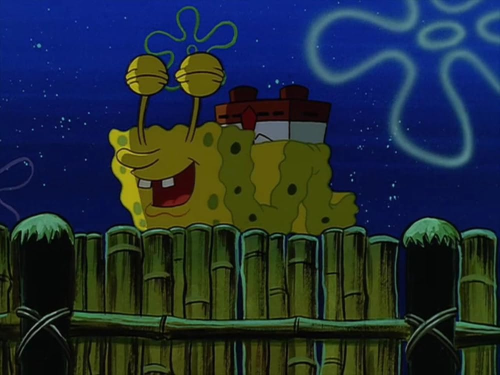
“I Was a Teenage Gary” is clearly a riff on I Was a Teenage Werewolf, and this episode is deeply disturbing for its heavy use of body horror. When SpongeBob leaves to go out of town, he asks Squidward to watch his pet snail, Gary. Squidward accepts (only so he can get some alone time), and then promptly forgets to look after Gary.
As a result, Gary grows ill, and a snail doctor must be called upon SpongeBob’s return. The cure? A shot of snail plasma to be carefully administered. With SpongeBob too squeamish to give Gary his medicine, Squidward offers to inject Gary. Except Squidward injects SpongeBob instead.
The result is a strange transformation for SpongeBob, one that definitely feels connected to I Was a Teenage Werewolf, something that makes me question how this was approved for a children’s cartoon. Talk about deeply unsettling! To boot, the snail transformation is contagious as we learn by the episode’s end with snail-SpongeBob looking for someone to bite…
Again, the body horror displayed here is why this episode stands apart from the rest. As SpongeBob progresses through various stages from sponge to snail, we see increasingly distressing behaviors such as eating snail food, meowing, and other very not normal SpongeBob things. This snail serum rips away SpongeBob’s sense of bodily autonomy as it shifts into something he can’t control in the slightest. Pick up almost any horror novel written by a woman in the last five years and you’ll find plenty of this thematic examination. Just to name a few, Such Sharp Teeth by Rachel Harrison, Odessa by Gabrielle Sher, and Itch! by Gemma Amor all tread similar ground.
To add to the horrific loss of bodily autonomy in this episode, the conclusion institutes the idea that this snail-condition has a desire to spread, tapping into the horrors of the uncontrollable, the hungry, and the infectious. These same fears appear in much more mature franchises such as The Last of Us and The Walking Dead. And great read-a-likes for this zombie/contagion theme are Leigh Radford’s One Yellow Eye and Girl in the Creek by Wendy Wagner.
Rock Bottom - Season One, Episode 17
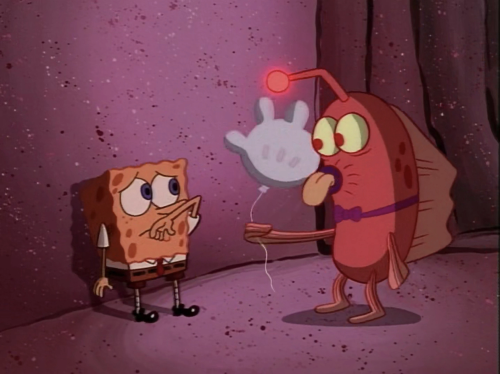
We all know the fear of being stranded, but there is something about “Rock Bottom” that delves into the deep, indelible dread of never being able to find your way back home. SpongeBob and Patrick board a bus to return home after hanging out at Glove World all day (think Bikini Bottom’s Six Flags). The duo take the wrong bus (barnacles!) and end up in Rock Bottom, a town nestled in the deepest, darkest trenches of the ocean with many strange inhabitants.
SpongeBob waits for the next bus to Bikini Bottom, just to miss it by barely looking away, though Patrick is seemingly able to catch it. He tries to ask for help only to be turned away or unable to understand what folks are telling him. And, he loses his only companion, his Glove World balloon. Things do work out for him, eventually. However, the waiting to see if a solution will be found, well, it’s just spine-tingling, even in my mature adult eyes.
I have a great appreciation for the way this episode explores unique facets of oceanography; but as a child, I vividly remember being terrified by the creature design surrounding some of the citizens of Rock Bottom. They don’t look like the fish we see in Bikini Bottom; rather, these folks have strange builds, interesting color schemes, big teeth, crooked spines, and other unconventional, alien-like structures.
Beyond this foray into the strange, this episode taps into some deeply existential dread of feeling lost that resonated with my very young self. The idea of knowing how to get home but being unable to do so feels connected to the same nightmare logic that keeps you running in place, an unsettling slow motion stuckness that screams with isolation. There’s a desperation to SpongeBob’s actions and his diminishing ambivalence towards finding a way home that I have certainly felt when getting that “No drivers in your area” message on the Uber app. And even more upsetting is the idea of seeking out help and being rejected multiple times, having to fend for yourself. And if isolation or lost horror is your thing, check out The Lost Girls of Hollow Lake by Rebekah Faubion, The Extra and The Other by Annie Neugebauer, or The Staircase in the Woods by Chuck Wendig.
Holy, Shrimp!
And to think this only covers one whopping season of the show? Horror absolutely thrives in Bikini Bottom, a fact that is proven with this small sampling of episodes and something I will happily further solidify if the demand for more SpongeBob-related horror is there.
Let me know if I should revisit season two through a horror lens in the comments.


Comments ()