
Sympathy for the Devil: The Miracle of “Mizumono”
Why the second season finale of Bryan Fuller's Hannibal is one of the finest romantic tragedies ever filmed.
We partner with Bookshop for all our book links. Any purchase you make through our links help support Darker Times.
Bryan Fuller’s work is not for everyone. He’s a divisive and often messy filmmaker with a reputation for being ~difficult~ to work with. But when he’s good, he’s so, so good. And he’s never been better than in Hannibal, his adaptation of Thomas Harris’s Hannibal Lecter novels. The second season in particular is near-flawless, and the season finale, “Mizumono,” is one of my favorite episodes of television ever filmed. It’s a Baroque chamber piece, a grand tragedy unfolding as a series of imploding relationships and cascading betrayals that ends in blood and rain. Most shockingly, though, “Mizumono” manages to place the audience in the uncomfortable position of feeling sympathy for a cannibalistic serial killer.
Fuller understands perversity: how violence can be elegant, how repeatedly trying to murder each other can be a form of romance. In the first season, Hannibal toys with the brilliant yet emotionally fragile Will under the guise of a therapeutic relationship, prodding and pushing at his malleable mind. Hannibal, we learn, likes to toy with his patients, nudging them towards violence. Will’s uncommon ability to empathize with killers, which makes him a valuable asset to the FBI, also intrigues Hannibal: how far can he push Will before he breaks? By the end of the season, Will has realized that Hannibal is behind the Chesapeake Ripper murders, but Hannibal successfully frames Will for the death of Abigail Hobbs and a number of others, and Will is imprisoned in a mental hospital.
In the second season, after an institutionalized (but much more clear-headed) Will sends a deranged orderly to kill Hannibal on his behalf, Hannibal relents. Hannibal’s experiments worked; Will is interesting now. He’s a killer. So Hannibal doles out evidence to the FBI that reveals Will’s innocence and redirects suspicion onto someone else for the Ripper murders. Once Will is free, he and Hannibal start circling each other once more–this time, on equal footing.
 Mads Mikkelsen
The back half of Hannibal’s second season is when the relationship between Hannibal (Mads Mikkelsen) and Will (Hugh Dancy) is at its most romantic. After a season and a half of vying for power and control over each other, they’re reached an equilibrium. They understand one another, even as they’re both engaging in active deception that functions as its own form of courting. Will has been leading Hannibal on, letting him believe that he’s won, that Will is a murderer now too, that the irritant journalist Freddie Lounds is dead by Will’s hand. Behind the scenes, though, Will is working with Jack Crawford (Laurence Fishburne) and the FBI to lay a trap for Hannibal. Hannibal, meanwhile, has been willing to believe in Will’s transformation, but not enough to be honest with him about the survival of Abigail Hobbs (Kacey Rohl), among other things.
As Hannibal and Will prepare to flee the country together, Hannibal picks up Freddie Lounds’ scent on Will, and only the faintest shift in Mikkelsen’s facial expression tells us that he immediately understands that Will’s been deceiving him. By this point, the pieces are set, and the trap is ready to close. Will’s ultimate loyalties are still unclear to us (and possibly even to him). He learns that the FBI are on their way to arrest Hannibal and calls him to issue a two word warning: “They know.”
When Jack arrives at Hannibal’s house, the episode explodes into ferocity. The two men clash like titans in a brutal, balletic fight. Hannibal is all lithe movement and hair trigger reactions, vaulting across the kitchen island toward his prey; Jack is more of a brawler, if a very well-trained one. They’re more well-matched than we might expect, and Jack holds his own admirably before Hannibal drives a shard of glass into the side of his neck. Jack retreats, locking himself in the pantry to try to staunch the bleeding. Outside, Hannibal launches himself over and over into the pantry door in an attempt to break it down.
Mikkelsen’s dancer’s physique is never put to better use in the entire run of the show than it is in this moment. As an actor, he makes great use of stillness: he has a sphinx’s face, almost masklike, that conceals his thoughts, and an ability to communicate the intricate clockwork of Hannibal’s mind through the smallest microexpressions. His default body language as Hannibal is a composed serenity that belies his internal violence; when that violence is allowed to come to the surface, as it is here, the contrast is seismic. Motion, after all, is only stillness interrupted.
When Will arrives at the house, the tone of the episode shifts yet again. The usual soundtrack, jangling and discordant, resolves into something more like elegiac post-rock. Will enters the kitchen to find a weeping Abigail waiting for him–Abigail, who was like a daughter to him; Abigail, who he believed to be dead; Abigail, for whose murder he was framed and imprisoned; Abigail, who Hannibal has been hiding from him in the cruelest way possible.
Before Will can process what her sudden, shocking reappearance means, Hannibal is behind him. “You were supposed to leave,” Will hisses. Dancy’s line delivery here seethes with frustration, desperation, and grief: he was working with the FBI to set Hannibal up, yes, but on some level he doesn’t want Hannibal caged or dead. Will's warning to Hannibal earlier in the episode was him offering up an out to the man he both loves and hates. From Hannibal’s perspective, though, Will’s betrayal is unforgivable. “We couldn’t leave without you,” he replies, plunging a knife into Will’s stomach and dragging it laterally, an echo of obligatory seppuku.
Now we come to the most intimate scene in the entire show. Hannibal holds Will’s face as he guts him, and as Will convulses in pain, Hannibal pulls him into a tight embrace. “A place was made for Abigail in your world,” he murmurs. “A place was made for all of us, together. I wanted to surprise you. And you, you wanted to surprise me.”
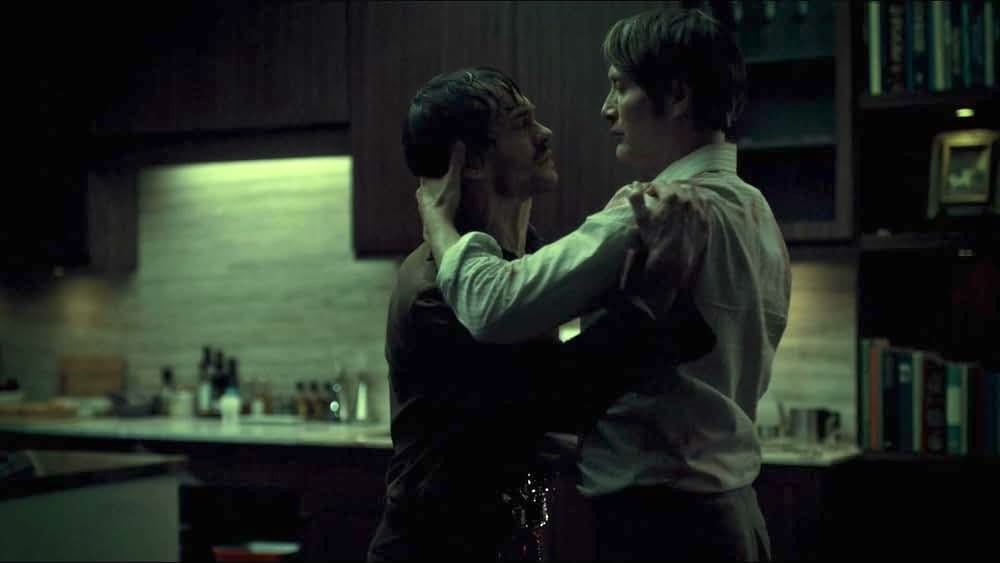
So much of Hannibal consists of characters talking around their true motivations and desires, speaking in arch and poetic code. Even as Hannibal and Will grow closer through the pursuit of their shared passion (murder), they have to veil their words. When Will brings what is ostensibly a cut of Freddie Lounds’ flesh to Hannibal’s table earlier in the season, he refers to it as “long pig.” So it’s striking when Hannibal tells a bleeding Will, “I let you know me. See me. I gave you a rare gift. But you didn’t want it.” This is as close to plain, honest speech as we ever get in Fuller’s version of this world.
This is also, I think, the only moment when we truly see Hannibal. For just a moment, the mask is off. It’s the closest he comes to being human. Hannibal, a character whose emotional landscape is tightly controlled and circumscribed, is genuinely wounded by Will’s betrayal. And because this is not a man who is capable of letting a hurt go unanswered, Hannibal calls Abigail to him and gently, almost lovingly, opens her throat. He makes Will, who learned only moments before that Abigail was still alive, watch her die.
(Source)
What’s pretty much beyond debate is that Hannibal Lecter is evil. In interviews, Bryan Fuller repeatedly stated that Hannibal is the devil (I vividly remember a particular interview that I can’t seem to track down now, in which Fuller points out that you never hear Hannibal’s footsteps in the series, because the devil doesn’t interact with the physical world the way the rest of us do). By this point in the show, we’ve watched this man commit more unspeakable acts than we can count. We’ve watched him torment and manipulate Will. We’ve watched him pull Jack’s terminally ill wife Bella (Gina Torres) back from the brink of a peaceful death based on a coin flip. We’ve watched him turn his victims into gardens, sculptures, art, into exquisitely composed gourmet meals. We’ve watched him feed people the flesh of their loved ones. We’ve watched him feed people their own flesh. So how is it possible for us to feel sympathy for Hannibal in this moment, even while he’s in the act of killing a young woman we’ve known since the pilot episode?
 Thomas Harris
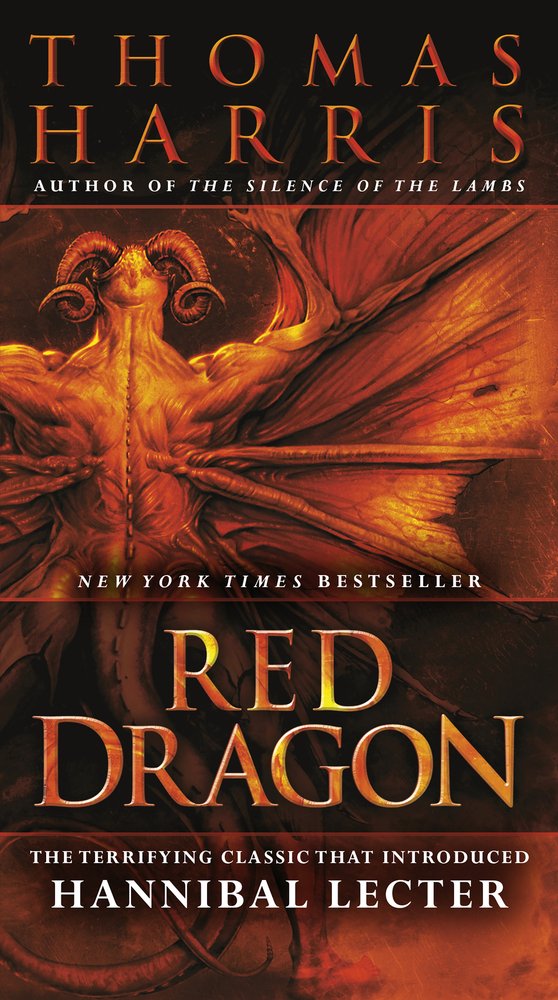
This is the brilliance of Fuller’s version of Hannibal and Will’s story. The cat-and-mouse procedural element of Thomas Harris’s novels and of previous screen adaptations becomes, in Fuller’s perverse vision, a love story. These two men understand each other on a level nobody else can even approach. We come to understand how lonely both men have been, and how much they need each other’s companionship. Like Hannibal, we’ve been genuinely unsure which way Will’s loyalty will break when push comes to shove. And it’s a credit to Mikkelsen’s towering performance that we feel how much Will’s betrayal hurts a man who shouldn’t be capable of feeling that kind of pain.
Artistically, formally, and thematically, “Mizumono” is perfect. The performances are top notch. The direction is in perfect alignment with the subject matter. It’s a genuinely fresh take on the source material, successful only because of the thoroughness of Fuller’s vision and understanding. It is one of the finest tragedies of modern television, a beautiful and profound romance shattered irreparably in a scant 42 minutes.
Comments ()