Disclosure Day and the Power of Truth
Emily liked it, Jessica hated it: Let! Them! Fight!
One of the first ideas we had for a recurring feature on Darker Times was “Let Them Fight,” where two writers with different opinions on the same piece of art hash it out. We believe that you can enjoy something and not be a mindless lemming. We believe that you can hate something without being a snob who just didn’t get it. We believe that reasonable people can love or hate the same thing and that they can talk about it without yucking anyone’s yum or vice versa! [Note from Emily: the phrase "yucks my yum" really... well, you know.]
The truth is that Jessica wanted to do this largely out of selfishness, because she is a hater. She hates so, so many things. But we believe there's an art to hating well. There’s an art to finding just the right way to describe an artistic failure just like you would with an artistic success. And why not do both in a respectful, friendly, no-trolling conversation between staffers?
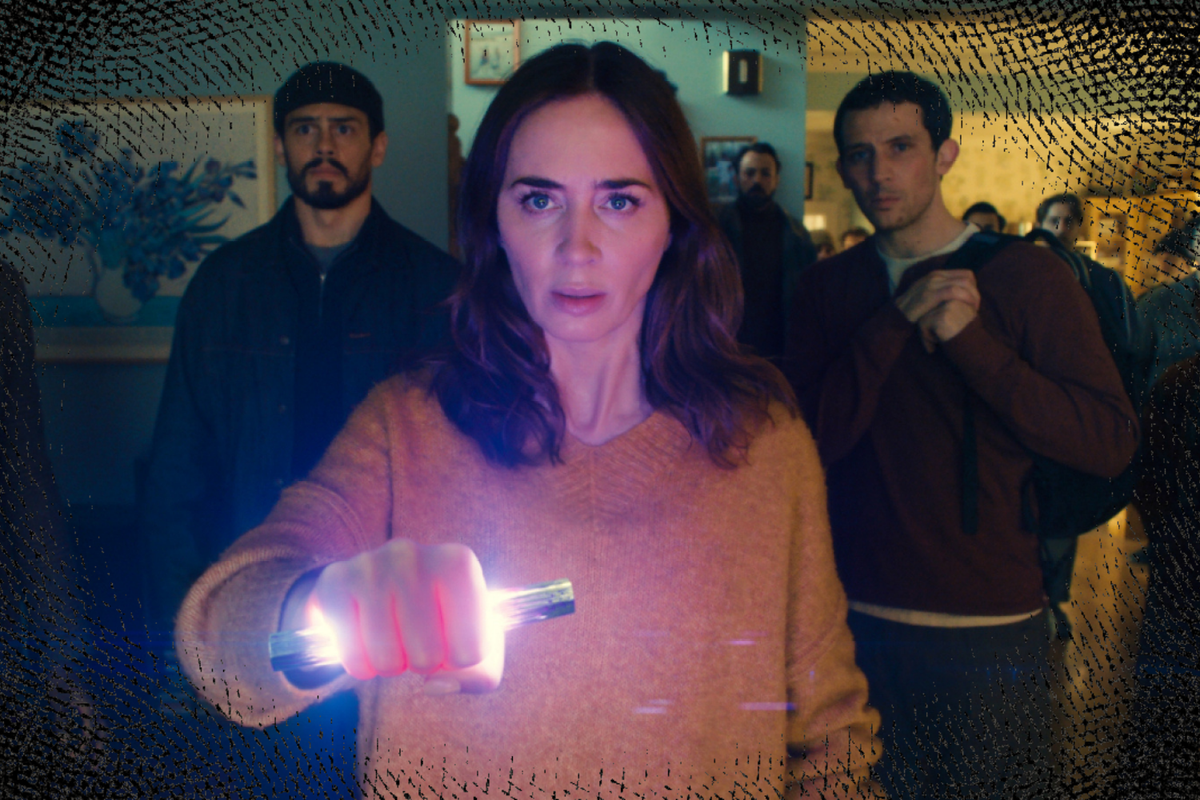
For our first entry, we're talking about Disclosure Day, the newest film from Steven Spielberg. The movie follows Daniel (Josh O'Connor) and Margaret (Emily Blunt) as they evade the clutches of a mysterious and malevolent corporation and try to bring the truth of extraterrestrial life to the masses.
Entering the ring: Jessica for the haters, Emily for the liked-it-well-enough-ers

Spoilers ahead for Disclosure Day: we'll be discussing plot points in detail, including the ending.
Jessica: Because I’m a very magnanimous person, let’s start with the things I liked. I liked being dropped into the middle of the story! I liked the train crash sequence! I also was deeply delighted by the train car full of pianos for no reason. I liked Emily Blunt’s weird psychic blabbermouth-y-ness. I even liked that the film ended at the exact point that it did. And that is… well that’s it.
Emily: Honestly, I love that you’re a hater. I didn’t love this movie, but I did like it, and I tend to like things that are weird and flawed and personal because at least the creator is trying to put their individual stamp on it. With Steven Spielberg, obviously we have this half-century body of work to draw on for reference, and his fascination with aliens is long established. I really appreciate that he seems to have something different to say about the topic in Disclosure Day than he did in E.T. and Close Encounters of the Third Kind. In terms of what I liked: the action sequences, of course (Josh O’Connor’s daring car theft rescue of Eve Hewson, with all its attendant driving-through-a-house chaos, really did it for me). Nobody knows how to move a camera like Spielberg, especially with longtime cinematographer Janusz Kamiński on board. I thought the lead performances were great (even if Emily Blunt’s painfully obvious buccal fat removal was distracting), and the culminating montage of extraterrestrial footage had me leaning forward in my seat. But let’s dive in: what didn’t you like?
Jessica: Oh, boy, where do I start? I hated the dialogue, that was all platitudes and generalities and never sounded like a sentence I would actually say. I was honestly troubled by the Morgan Freeman-ification of Colman Domingo (that could be a whole essay someone should write). But I think the central thing that made me want to pull my hair out was that this movie pretends like it takes place in our present world. It has a lot of signals to show us that it is set now. It has a tech billionaire as its primary villain. People use smartphones. There is a generalized anxiety and the feeling that we are on the verge of apocalypse. So, yeah, you’ve given me all these This Is Right Now signals … only to actually be about an entirely different world.
This movie wants truth to be the thing that is powerful. The thing that will save everyone. And I don’t think truth is the thing that will save us. I think we are long past that. We are in a world where the truth doesn’t change anything. We are in a world where the truth can’t even be agreed upon, where almost anything will be accused by those against it as being fake. It’s a world where anything could be fake. We all have this cynicism in us now, and it’s there for good reason. Much of this movie felt like a relic to me, it would have been a great mid-90’s effort. But nothing felt as out of touch as the idea that any one truth would matter this much. Even aliens.
Emily: So I think that’s an interesting point, even as I don’t quite agree. When I left the theater the other night, I was chewing over whether that Spielberg-style optimistic outlook still works in 2026. I don’t think it does, but I also can’t blame him for trying, you know? I don’t need my fiction to adhere to reality with complete fidelity; I know this is, to some degree, fantasy. Spielberg clearly wants to believe that we are good, that we can be swayed through awe, and by people trusting us enough to tell us the truth. The cynic in me feels a little bit “That’s nice, grandpa, time for bed,” about it, but the desperate optimist in me kind of wants to lean my shoulder against his and dream of a better world, one that could stop dead, even on the precipice of World War III, and have this collective experience of discovery.
One thing I absolutely did not buy, though, was Colin Firth’s reversal at the end. We’re supposed to accept that he, what, completely changed his mind because Colman Domingo pointed out that he lost his way after his wife died? This man who we saw actively involved in the torture of an alien earlier in the movie? That was too far for me.
Jessica: Spielberg optimism has been a lot of what seems to be getting to people with this movie. And I admit that I’d basically quit Spielberg a long time ago. (I didn’t realize how much I quit him, but he had an 11-movie stretch where I saw only ONE of the 11.) But I don’t know that it’s the optimism or the earnestness that bothers me. After all, it’s that optimism that makes E.T. and Jurassic Park work as crowd-pleasers. There is some singular emotional thread he’s able to pull that I can be very vulnerable to. I came in ready for optimism, hoping that it would hit the way it used to.
I don’t know how much of this to blame on Spielberg and how much to blame on the script. It’s not optimism that I’m mad about. It’s the flatness. It’s the lack of nuance. It’s a movie where all it takes is one person to say the right sentence and a woman will leave a violent relationship. A movie where there are deus ex machinas hidden in every corner to get us out of that jam and on to a new track. We don’t have real characters here who get to grow and learn something. We don’t have a real purpose for the disclosure besides all Josh O’Connor’s blah blah blah about truth. I think about the messiness of the family in E.T. or the way you see Grant begrudgingly take on a fatherly relationship to the kids in Jurassic Park. There is never a feeling that these are people, that they will be changed, that they will be better. Just like the flatness of this world. It is so overly simplified. World bad. Truth better. I demand more! Instead of some real growth all we got was a preternatural understanding of how to produce a local television broadcast (is that something they teach you in cybersecurity hacking school?). If there was something to actually cling to here, stakes beyond TRUTH, I think I could have gotten on board.
(And I had to actively look at my feet during the alien torture, no thank you, that isn’t the kind of powerful message I mean.)
Emily: Yeah, the characters are definitely thinly drawn, which I don’t always mind in a plot-driven story, but in a movie where the whole point is ~the innate goodness of people~ it does undercut the message. David Koepp wrote the screenplay, and I think he’s generally a workmanlike writer whose scripts live or die by the director who molds them. (He has a long, mixed history with Spielberg–he wrote Jurassic Park, but he also wrote Indiana Jones and the Kingdom of the Crystal Skull, so, uh, take from that what you will.) I think a lot of the character development was supposed to rest on this mysterious, but ultimately predictable, connection between O’Connor and Blunt’s characters. I definitely rolled my eyes at the fairytale childhood wonder/terror flashback and its Polar Express-esque CGI, but that’s such a classic Spielberg theme that complaining about it feels a little bit like going to a steakhouse and complaining when you’re served a steak.
But ultimately I go to a Spielberg movie to be entertained, and I was! It got my heart racing (I love that even as a seasoned movie guy, I can still be thrilled by a sequence like the train escape). I was even moved by Courtney Grace’s scene-stealing performance as the news anchor who reacts to the disclosure in real time.
Here’s a question for you: what did you make of Eve Hewson’s character and the religion subplot?
Jessica: Oh, I love a loaded question. I found it boring. It was very underdone. When we meet Eve we know basically nothing about her or about her relationship with Daniel. We know he’s surprised she used to be in a convent, but I feel like I would be surprised to learn that about literally anyone, even someone I just met on the street, unless she was already wearing a habit. I found it to be yet another cheat in the script, a placeholder to stand in for character development. We know almost nothing about why she left the convent, or how she really feels about her actual faith. Maybe there were a few lines? They didn’t make an impression. But the image of a woman squeezing a cross until she draws blood is one of the more memorable images of this film that has a lot of memorable images.
It felt cheap. A shortcut for the audience AND the villain to be like, “Now I can truly take advantage of this person!”
Honestly, there is a weird religiosity around the film (which isn’t unusual with Spielberg, but it hit harder here) that had me grasping for something. Part way through I realized that the movie this most made me think of is Escape to Witch Mountain (1975), a movie I passionately loved as a kid. If you’re not familiar with this Disney 70’s semi-classic, it’s about Tony and Tia, two kids with special powers they don’t understand, with fragmented childhood memories they’re trying to explain, behind hunted by an evil millionaire. Sound familiar?
When I watched Escape to Witch Mountain as a child, it had this whole other level of strangeness, full of things I couldn’t fully understand happening for reasons I didn’t comprehend, giving it almost a religious aura. As soon as I’d made that connection, Disclosure Day lost me. At least Witch Mountain is a movie where the kids wear cool bellbottom jeans and there’s a fun harmonica with kinetic powers along the way. And it ends with the kids learning they’re actually aliens themselves, which I found more fun and compelling. I personally would have enjoyed a little more fun, put Josh O’Connor in some bellbottom jeans, at least!
I will, however, give you Courtney Grace, who was as fantastic as everyone is saying. Even though I didn’t think her character’s reaction was any more realistic than all the spellbound crowds.
Question for you: how do you feel about the old-school aliens? My teenager was NOT having it. The children have forgotten the old ways.
Emily: I’m with you on the faith subplot! I thought it was underdeveloped and to the point of pointlessness. As for the aliens: you will NEVER see me complaining about an old-school Grey. Those are the aliens I grew up on (thank you, The X-Files).
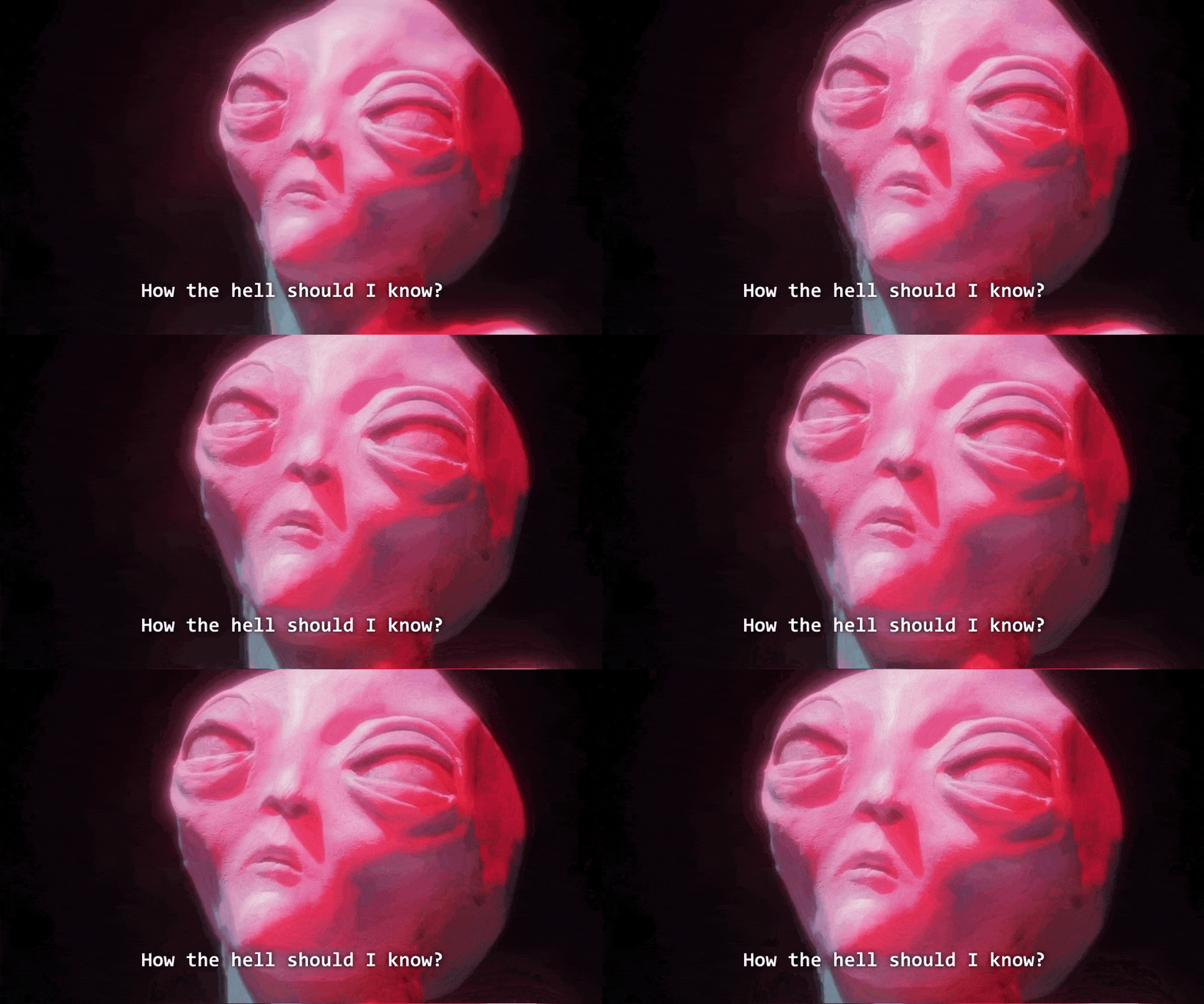
I also loved Escape to Witch Mountain! Great minds, etc. But the movie I kept flashing on while watching Disclosure Day was The Day the Earth Stood Still (the 1951 original, I mean – do not even speak to me about the awful 2008 remake). I think it has to have been formative for Spielberg, right? It’s a movie where a benevolent alien emissary and his huge, silent bodyguard robot come to Earth with a warning for humanity: calm the fuck down or we’ll blow your shit up. It’s a direct response to the nuclear age, coming a mere six years after the Americans dropped nuclear weapons on Hiroshima and Nagasaki. In Disclosure Day, news reports tell us the world is on the brink of potential nuclear war; we hear snippets of chatter about Russia and North Korea and people evacuating residential areas around military bases. Both movies end on a challenge to humanity: in The Day the Earth Stood Still, it’s the aforementioned choice. In Disclosure Day, it’s Emily Blunt’s delivery of the alien’s message: “Listen.”
In both movies, the aliens are violently attacked by humans. But I think what Disclosure Day lacks is the bite of that ultimatum. Spielberg tells us these aliens consider empathy the foundation of culture and communication, and we’re never given any inkling that they’re violent or aggressive. So they come to Earth over and over and ask us to listen (to them, and to each other). But I do think Spielberg expects the revelation of alien life to be the catalyst for change, whereas The Day the Earth Stood Still fully anticipates that this knowledge alone likely won’t be enough of a motivating factor for us to alter our trajectory.
Jessica: This is where I admit I’ve never seen The Day the Earth Stood Still but you’ve definitely sold me on it. And I think you make an excellent point. As much as I think ending on that “Listen” was powerful in some ways, it’s still a hedge. So much of the alien voice that is supposedly so powerful is actually missing here. The translated version of it we get is convoluted, and delivered in the midst of so much other plot development that we don’t really get the time we need to focus on it.
I have to wonder what good old Tony Kushner would have done with this material. I know he and Spielberg have a good working relationship, and I thought The Fabelmans was a personal best for Spielberg when it comes to real emotional heft and making room for complexity and nuance.
For me, so much of this movie feels like a throwback. The government conspiracy, the surely-we-have-better-CGI-than-this animals, the grey aliens, and, more than anything, the idea of an optimistic and caring collective. I want to want that earnestness. Instead, the only thing I wanted to do when I left this movie was go watch Close Encounters of the Third Kind or E.T. to make sure I still have the ability to let Spielberg move me.
Emily: I get you. I don’t know that I’ll run to rewatch this one when it hits streaming, but I’m still glad I saw it. Because hey, aliens, amirite?
Now let’s open this fight up to the audience: what did you think of Disclosure Day? Where do you stand on late-career Spielberg? And, most importantly: are you team Grey?

Comments ()