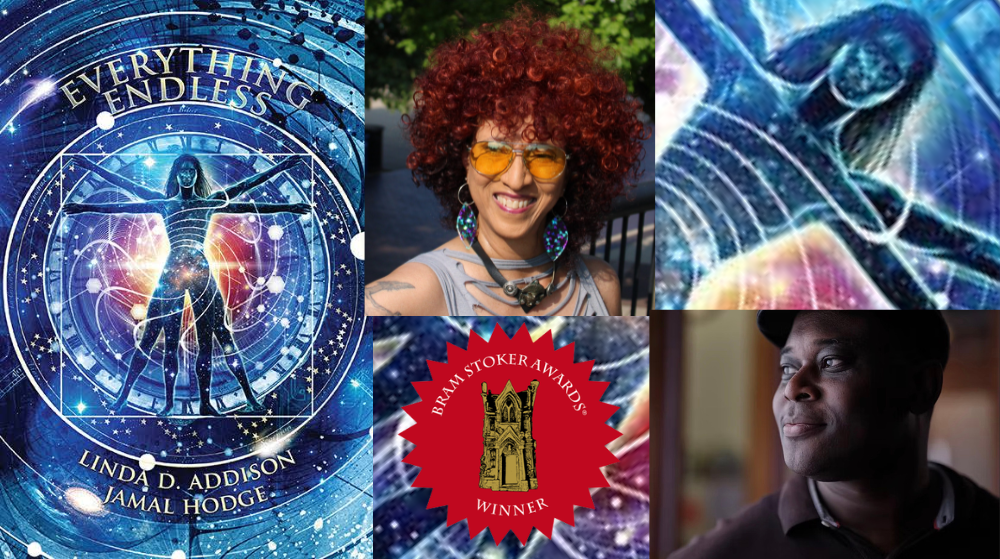
An Interview With Bram Stoker Award® Winning Authors Linda D. Addison and Jamal Hodge
If you write about humans, no matter where you see them in the universe, you’re going to have some shadow work involved.
Welcome! You’ve come to Darker Times during a strange and special time: 💫 the Darker Times Subscriber Drive 💫. We’re trying to hit 500 paid subscribers by August 14th or else we will all be hunted down and skinned alive in our beds. Ha! We kid. But not really. To keep Darker Times running, we need money—hot, wet, bloody money—to keep the lights on and the words flowing. If you like this post or even if you hate it, consider subscribing in exchange for great, funny, analytical horror coverage.
We partner with Bookshop for all our book links. Any purchase you make through our links help support Darker Times.
Last month at StokerCon, the winners of the 2025 Bram Stoker Awards® were announced, and Darker Times was able to get an interview with the authors of Everything Endless (Raw Dog Screaming Press), Linda D. Addison and Jamal Hodge. As a part of our July subscriber drive, agent, writer, and editor Arley Sorg was lovely enough to interview the two authors for us.
Jamal Hodge is a Bram Stoker Award-winning writer, a Nebula Award finalist, and an award-winning director. His producing credits include the Academy Award–nominated documentary Armed Only With a Camera: The Life & Death of Brent Renaud (co-producer) and the upcoming animated feature film Pierre The Pigeon Hawk. In literature, he is an Elgin Award winner, a Dwarf Stars Award winner, and a Rhysling Award finalist, his forthcoming books, I’m Not a Good Person, I’m a New Yorker (September 2026, Crystal Lake Publishing), and the anthology Shards of Gotham: New York City Through The Looking Glass (June 2027, Ruadán Books), continue his exploration of pain, identity, and redemption. www.writerhodge.com
Linda D. Addison, six-time recipient of the HWA Bram Stoker Award®, including Everything Endless (written with Jamal Hodge), the first African-American recipient of the HWA Bram Stoker Award®, received the HWA Mentor of the Year Award, the HWA Lifetime Achievement Award and SFPA Grand Master of Fantastic Poetry. Her site: www.LindaAddisonWriter.com.
At some point you were brand new writers with no publications, but with hopes that one day your work would be out in the world, getting read by lots of people. What was the tipping point where you said, you know what? I’m going to actually give this a real shot, I’m going to try to make this writing thing happen.
Linda: In elementary school up through high school, I just wrote wild imaginative things because they came to me. In high school, I started writing back blurbs for science fiction books I imagined myself writing. It wasn’t until I got to college that I actually started looking at writing and submitting to markets. That was the beginning of wanting to see myself in print.
Jamal: I started writing as a child. I grew up harsh in the South Bronx, and when I needed to get away from that painful reality of my circumstances I would write stories. It was only as a grown man, and through the guidance of many mentors, that I made the leap into professional publishing.
What were some of the most memorable differences between what you thought a career in writing would be, versus the realities of a career in writing?
Linda: When I decided to submit my work I read about the life of writers, what they were being paid, and realized that the chance of making enough money to live on was very rare. Writing wasn’t something I chose, it was the natural outlet of my constant imagining, so I gave up thinking of it as a career to live off of and ended up working in Computer Programming as a career. Writing happened all the moments in between working and sleep.
Jamal: Like Linda said, writing is not something you choose. It’s a blessing and a curse that compels you to bleed on the page. It chooses you. I would add though, that I’m more of a storyteller than just a writer as I’m also a filmmaker and a teacher.
You both write in other kinds of formats, but we’re here today to talk a bit about poetry and your book Everything Endless. What is your relationship with poetry, compared to short fiction or other kinds of writing?
Jamal: I never truly thought of myself as a poet. I always thought being a poet was just soft. But I’ve since learned that poetry in all its forms is some of the deepest, riskiest work you can do as a writer. It requires tremendous courage to be so vulnerable and let people view the most intimate searching of self. So to me, poetry is more intimate than short fiction or even novel writing. Poetry is the exposure of the fundamental building blocks of the heart in relationship with the world, given form. It is the music of silence.
So yeah, I fucks with it now. Lol.
Linda: Poetry has been my first creative writing voice since I can remember, like a musician hears music in their heads. I have published a lot more poetry than fiction in all these years. I have filled (and continue to fill) over 200 journals with thoughts and pieces of poetry that eventually become the books that I’ve written over these years. So even though I have written fiction, nonfiction, and now working in the arena of novels, so much of the ideas and characters come through the music in my head, which is basically poetry.
What did this collaboration look like, how did things work in terms of developing pieces, making decisions, and putting the book together?
Linda: It looks perfect to have both names on Everything Endless because this was born from the call-response method we used to inspire each other to create work beyond what I could write by myself. I would like Jamal to talk about how the book came together since it was his vision that brought this book into both our lives.
Jamal: Well to tell the whole story about how this book came to be, I first have to talk about how Linda inspired me through one of the darkest times in my life to embrace my poetic voice in order to free myself from depression.
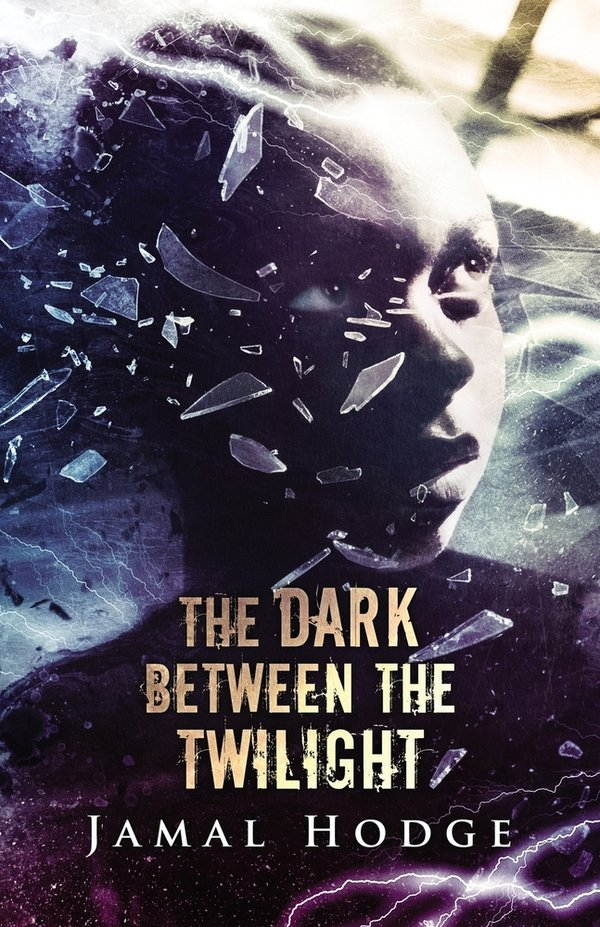
During the pandemic I couldn’t write and had fallen into a deep depression. Linda suggested that I express my feelings through the form of poetry. That expression later became my Bram Stoker nominated The Dark Between the Twilight.
From then on, I wanted to collaborate with Linda on a poetry collection, but I wanted it to be something that would serve her and her legacy. I wanted it to be something that I knew she had time for, but in a space she had yet to fully explore as a poet, which was dwarf poetry form.
I know that Linda is into the science of dimensions, theories of spacetime and reality. So I suggested we do something that would compress large ideas into shorter temporal forms of poetry. And Linda basically said no for two years, lol. But EVENTUALLY after we spoke about the book at random over and over again it took on a fetal design around a list of powerful questions that needed answers only she could provide.
Everything Endless was made to explore the interest of her very nature.
From there, Linda took the lead, and we created a filtering system where we would read each other’s poems separately and rank them into categories of green, yellow, or red. Anything red would be eliminated, anything yellow had the possibility of being fixed, and green was a go. I think Linda had to discard like three or four poems. I had to get rid of twenty.
After we organized all the poems we needed, we read through the entire book together in real-time, and if anything stopped one of us, we paused and edited it on the spot. It was all cohesive and effective. And honestly, tremendously fun.
I’ve seen you both in person; we’ve had meals together, and I had no sense of bitterness, enmity, or unresolved problems between you. What were the keys to making collaboration successful, to putting a book together and remaining friends afterward?
Jamal: Linda is like my feminine mirror in many ways. I honestly couldn’t imagine having enmity or bitterness towards her in any capacity. And that might be the key. Alignment. Collaboration works best when the energy is complementary, one mind recognizes the other and the book’s pursuit is rooted in a complementary philosophy. In the end, the journey should make you veteran friends of a single trench. This collaboration has made me a far better poet and writer through osmosis. Linda is an extraordinary teacher of the craft; one must grow strong to ride along with The Mother of Dragons.
Linda: What Jamal beautifully said is how I feel. I also expanded in many ways as we wrote together. It was an incredible experience, and I couldn’t be happier that it has received such recognition in the land of speculative poetry! (“The Mother of Dragons,” LOL)
Readers have all kinds of thoughts and assumptions about horror. This book is an Elgin nominee and just won a Bram Stoker Award for Superior Achievement in Poetry. This means that two important groups in speculative writing fields see it as both “horror” and “science fiction.” What is horror poetry? What is science fiction poetry?
Linda: It has been said that horror is an emotion, a feeling of discomfort, fear, unsettling. In our book, we explored what drives humans and how we fit in the infinite universe. There is psychological horror in many of these poems, because if you write about humans, no matter where you see them in the universe, you’re going to have some shadow work involved.
Many years ago when I won my first Bram Stoker, I embraced the concept of psychological horror and that my poetry fit there. Until then, I thought I was just writing moody, weird stuff, lol.
Jamal and I wrote as it came to us, keeping what fit the journey of humanity in the universe that unfolded. I’ve always been obsessed with physics/quantum mechanics and the psychology of human behavior. Jamal and I have had many philosophical conversations in these areas. We didn't sit down and design the book for every speculative area. I never have done that. In all my years of writing speculative poetry, I've learned to leave the definitions of what is horror/science fiction/weird to the readers.
Can you tell me a bit about the title, as well as about the sections of the book?
Jamal: Everything Endless’ title came about during a deep philosophical conversation around the possibility of doing the book. Linda said the words in random explanation about time and then I said that those words should be the title. It was a eureka moment! We both agreed and the rest is where we are.
Linda: It was pretty exciting when that title surfaced because we both felt the energy of that being IT. The section titles are extensions of the road the book was on, is there a beginning, is there an end, and what is the relationship between past present and future? The section titled Seven/Now came from the idea of “The Seven Hermetic Principles”, which Jamal introduced to me as an area to play in.
There are elements here that those of us with less experience in poetry may not know much about on certain levels. Many of the pieces play with form. A few examples: “Law #7: The Law of Gender (Mutable)” which creates visual shapes; “Soul Song” which is written in brief pairs of lines until the final line; “Beginning”, which is entirely right justified; “Celestial Life” and “Gravity Embrace”, in mirrored shapes that together create an image which reminds me of a galaxy seen from the side. Can you please talk about one or two pieces from the book in relation to format or structure and share about your decisions around form for those pieces, or perhaps what the structure means?
Linda: I love playing with different poetry forms. I've even taught workshops about writing poetry forms. Jamal also has different forms in his poetry collection, The Dark Between the Twilight. So there was no way this collection wasn’t going to have different forms in it.
A lot of the poems we wrote were call-and-response, meaning one of us wrote a poem, and the other one would write a poem inspired or reflective of the other’s poem meaning or shape. For example, Jamal’s poem “Many Makes A Movement”, inspired by The Law of Cause and Effect inspired me because he had three lines stanza, than a one capitalized word pattern, so when I wrote my poem for that law, “Singularity Dream”, I used the same visual effect, but I used the same word twice with two stanzas, one stanza reflecting the word through the eyes of the Universe, and then the second stanza in italics reflecting a human’s experience of that word.
The thing about form is that each reader responds to a poem from the point of view of every experience of their life. As a poet, we can create poetry to inform you how we want the poem to be read, but we can’t control what that will mean to you. I love that you saw the mirrored shapes in “Celestial Life” and “Gravity Embrace” as a galaxy seen from the side. Was that our intention or was that something that occurred to you because of images that you’ve come across in your life? Does it even matter?
Best Poem is a new award for the Nebula Awards, and a number of other major genre awards have also started to recognize speculative poetry. How do you feel about this? What is wonderful about it, and what are the problems that some folks may not know about?
Linda: The fact that our last poem in Everything Endless, “Thought You Always Are”, is an SFWA Nebula finalist is a wonderful and unexpected honor. My guess is that major genre organizations are beginning to recognize speculative poetry because of the increase of speculative poetry collections over the last 10 or more years and attention put on them by organizations like The Science Fiction & Fantasy Poetry Association (SFPA) which was founded in 1978 to recognize speculative poetry. Many poets also write short fiction and novels, so as poets become members of organizations like Horror Writers Association (HWA) and Science Fiction & Fantasy Writers Association (SFWA) they created a conversation between speculative fiction and poetry and the need to honor poetry.
What are your feelings about Everything Endless winning the Bram Stoker Award®? Was it expected? Was it overwhelming? Does it create added pressure; are there thoughts or complicated emotions that we might not realize come with winning this award?
Jamal: Well for me, it was one of the most extraordinary moments of my life as an artist. It was one thing to win my first Bram Stoker award with the greatest to ever do it, Linda D. Addison, but it was a whole other thing symbolically for the first black woman to ever win in poetry to uplift the first black man to winning in the same category.
Can you imagine?
And then for us to be given the award by Ace Antonio-Hall (aka Nzondi) who himself is the first black man ever to win in a novel category (Young Adult Novel category). It was an honor beyond words. Blackity, blackity, black! It was all I could do not to cry on that stage, but luckily, I was able to resist, or I would never be allowed back in the old hood again, lol.
But honestly, I will never forget the amount of love in that room when Linda and I were announced as the winners, and will carry that memory with me to the grave. The realization that now there is a community of people actively waiting for my work as a writer is an invigorating feeling. It’s liberating and perilous all at the same time. I welcome it.
What is your best advice for folks who want to publish a book of horror poetry?
Jamal: The courage to be vulnerable enough to expose the full self in your writing and your ugliest and most idealistic beliefs, is far more important than your understanding of poetic form and technique. Those will come in time and with practice and learning, but as with all good writing, the best way to learn is to write yourself. One good thing about horror poetry is that it makes sense of all scars and explores the most universal of all sensations: pain, fear, and the hope to rise above it.
Linda: I’m going to say the same thing that Jamal said and that is the most important thing is to write your first draft from the deepest part of what angers, hurts, frustrates you, and then when you edit, you can shape it into a form, you can rewrite it anyway you want or you never show it to anyone but, it’s important to be in touch with that authentic point of pain. That is what will make your poetry stand out. Then like any writing, after you’ve edited as much as you can, try to find a group or people who can read it and give you feedback. For me that came from a writers group, Circles in the Hair (CITH), that I became part of in New York City that came out of a workshop we took. While you’re writing, you should also be reading other horror poets. And remember that metaphors are your friend. I’ve said I can write a poem about a dragon and be talking about racism.
Is there anything else you’d like folks to know about yourselves, your work?
Jamal: Yes, there’s been a lot of good going on. This year I’ve been published over 18 times and have short stories in many anthologies like Of Dread, Decay, and Doom, and The Big Bad Book of Kaiju. I also have a new collection of poetry, I’m Not A Good Person I’m A New Yorker, being released September 1st by Crystal Lake Publishing. It’s a social horror book about an abusive relationship with the world’s greatest city and is my most raw and uncompromising poetic expression to date. Lastly, Shards of Gotham: New York City Through The Looking Glass, an anthology that delves through the history, culture and boroughs of New York City through a speculative fiction lens, with a legendary TOC of writers like Tananarive Due & Steven Barnes, Jonathan Maberry, Paul Tremblay, Sheree Renée Thomas, Ai Jiang, Tim Waggoner, Clay Chapman, L. Marie wood, Eugen Bacon, James Chambers, Linda D. Addison, John Skipp, Nzondi, Cindy O’Quinn, Matthew Kressel, Geneve Flynn, Lauren Elise Daniels, David Mercurio Rivera, Jennifer Anne Gordan, Rob Cameron, Dennis Crosby, David Geffen, J. Daniel Stone, David Rheingold, and Kareem Hayes.
The anthology will be released by Ruadán Books in June 2027 and is a banger. To stay connected please subscribe to my website at www.writerhodge.com.
Don’t ever give up on yourself and trust your voice. You don’t have to be the best to be the best you.
Linda: (https://LindaAddisonWriter.com/) In 2026 you can find my work in anthologies:
Sauúti Terrors: The Dark Side edited by Eugen Bacon, Stephen Embleton, Cheryl S. Ntumy (Flame Tree Collections) with my poem “The Tale of Elders Silent Screams”, which questions what could happen to elders’ soul sound in the sonic storms of planet Órino-Rin.
Waterborne edited by Henry Herz (The Brothers Uber) with my poem “The Wind, Thunder & Water Protector”, inspired by Mishipeshu: The Water Panther of Anishinaabe Legend and what happens when the monster isn’t what you expect.
The Big Bad Book of Kaiju edited by Jonathan Maberry and Henry Herz (Titan Books) with my poem “Who’s on First”, adventures with a many-headed Kaiju (Ghidorah).
Carnivores & Other Lovers (a collaborative poetry collection written with Consuelo G. Flores, Andrea Goyan, Elizabeth Eve King & Elizabeth Wong).
All Hallows Eve edited by Ellen Datlow (Titan Books) with my poem “Merciless Feast”, what could go wrong at an isolated village’s annual feast for the dead?
Also in Tar Baby magazine, produced by the Toni Morrison Foundation, the Afrofuturism issue curated and guest edited by Sheree Renée Thomas contains art and my poem “Song of the Timeless” inspired by Igbo Landing, a historic site, and the law of conservation of mass.
In 2027 look for my work in:
Shards of Gotham: New York City Through The Looking Glass anthology edited by Jamal Hodge; with my opening poem “Behold The Pieces” and ending poem (with Jamal) “An Algorithm for All Time”, journey with a new life form as it takes in the stories from the City of cities and in the end becomes something greater.
Where the Devil Stands anthology edited by Johnny Compton (Titan Books) with my story “Forever Young”, a reminder to be careful what you wish for.
Arley Sorg is an associate agent at kt literary and Senior Editor at Locus Magazine. He is a two-time World Fantasy finalist and three-time Locus Award finalist for his work as co-Editor-in-Chief at Fantasy Magazine. He is also a three-time Ignyte finalist, a Solstice recipient, and more. Arley is a book reviewer for Lightspeed, an interviewer for Clarkesworld, and a columnist for F&SF, among other projects. He was the week five instructor at the six-week Clarion West workshop, and has taught at and been a guest speaker for numerous other organizations, including the Odyssey workshop, Cascade workshop, Wayward Wormhole, and many more.

Comments ()